CPF Nomination

Full article: Article by Lorna Tan.

This is an insightful article by Lorna Tan on CPF Nomination- even I gained new information that i previously did not know.

CPF nomination is something that I have always gotten my clients to do as soon as they start on the legacy planning process. Reason being that your written will does not cover CPF monies. However, there are still many individuals who believe that it is ok to solely rely on the intestate succession act (ISA) for distribution.

However, the below tidbits of information may change your mind on how a specific nomination can work in your favor.

img_4922

Prior to 2011, this was not possible and CPF would typically pay out a cash lump sum to the beneficiaries. However, with this option, CPF members can create a safeguard- and ensure that their nominees use the money gradually (via enhanced retirement payouts/ ensuring sufficient money to cover for healthcare needs)


img_4924img_4923

(The only exception to this is if the nominee is the deceased widow.) This could potentially be an issue if a CPF Member leaves behind no insurance/savings and is solely depending on his CPF Monies to care for his children. In view of this, I believe it is exceptionally important for CPF members to decide on the nomination rather than follow the ISA, where by default, spouse gets 50% and children get 50%.

img_4925Unknown to many, CPF actually has the special needs saving scheme that can help parents of children with special needs to save for their long-term care needs. Parents can nominate their children to receive monthly disbursements from the parent’s CPF savings after death. This scheme is administered by the Special Needs Trust Co and is probably worth looking at if of relevance.

What insurance to get for your newborn? Part 1

First and foremost, it is good to be back after a long hiatus from writing. Work and life’s been busy. Over the course of last year, I have held seminars at various corporations, from online retailer Zalora, to hotels such at M Hotel and other professional services firms such as NICE Systems, Perennial Real Estate etc. But now that things and processes are more settled, I’m glad to be back here 🙂

I have also made some other ‘progress’ in life. After finding my beloved, we also purchased our first residential home, got married, and I am also now hosting a little bun in the oven.

so what’s better to write about, but this?

newborn-needs

Of course, it is still a little premature for me to be writing about this since it is still months before the little one will be born. but seeing how this is now a common topic amongst my peers- some who just turned mummies and some who are becoming mummies, I feel like now would be the best time to start the series. What insurance will my newborn need?

(i will not be talking about the prenatal maternity insurance here, but you can text me separately to find out my view on it, and to find out which plan is the most ideal. For the newly weds who are excited about family planning and want to know more about the International Health Plans that cover for delivery costs, feel free to just give me a call too)

So first off…

health-ins

This is perhaps, the most straightforward and important insurance to get for our children. Upon birth, your child will be covered under the Medishield Life Scheme, which is the nation’s health insurance.

Medishield Life covers for Government Hospitals for B2/C wards, and limits of coverage and co-payment applies. So most parents would enhance the child’s coverage to a Private Medical Integrated Shield Plan that cover the child fully, from Govt to Private hospitals, thereby transferring the financial obligations to the insurer in the event of hospitalisation (be it due to high fever/ any unfortunate complication when young).

Enrolling our newborn when they are young is also crucial because more likely than not, they would be at their healthiest stage, with no prior medical records/conditions.

There are 6 different insurers in Singapore providing Private Medical Integrated Shield Plan and each insurer provides the coverage via 2 parts – Main Plan (takes care of almost 90% of bill) and Rider Plan (takes care of the remaining 10% of bill + other benefits).

Below is a simple comparison on the relative strength on each plan (based on private as-charged cover with rider). Because it is still best to discuss this in detail with an advisor to find out what is best for you, I have excluded the names of the insurers specifically. Drop me a whatsapp and i’ll be happy to share in great detail about it.
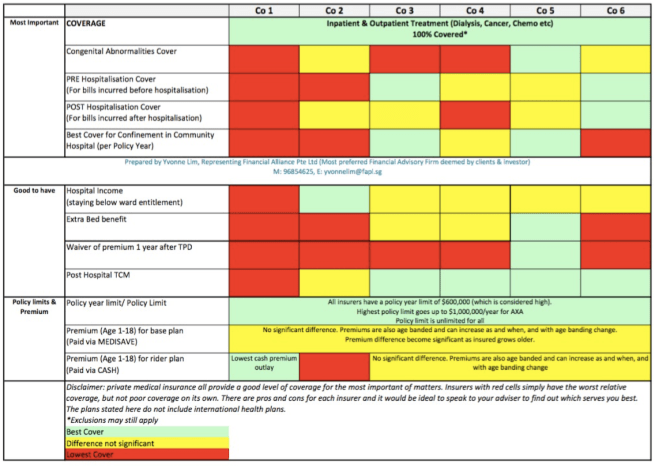
Shield Plan.png


Disclaimer: Info correct as of date of post.
private medical insurance all provide a good level of coverage for the most important of matters. Insurers with red cells simply have the worst relative coverage, but not poor coverage on its own. There are pros and cons for each insurer and it would be ideal to speak to your adviser to find out which serves you best.  The plans stated here do not include international health plans.

So here it is, the first part of the <What insurance to get for your newborn?>  series. Do look out for more in the coming week 🙂

and for my dear friends and clients who are reading this, if you have had good experience with how I have assisted you with your finances (be it for insurance or investment), do share this article  and my services with your loved ones too. So I know that I have been doing the right thing and can continue doing it for more people.

And for those who are reading this and may be shy to ask more, please do not be. Regardless of whether we set up a advisor-client relationship or not, I will always be more than happy to share. likewise, just drop me a FB message/text.

 

yvonne

Most Preferred Financial Adviser – Financial Alliance

Was happy to participate in the recent InvestFair and even happier to know that we are deemed as the most preferred Financial Adviser to work with. Life is especially sweet, when the we receive such actions and words of appreciation from our clients.

aaeaaqaaaaaaaaf8aaaajgqzodeznduwlwu2zgytngq0zi1inzg0lty5m2mzodbmzguwmq

Full feature here, extracted from BT Invest

Most Preferred Financial Adviser – Financial Alliance
Independent Advice, Fintech & You Put Financial Alliance in the Forefront

INDEPENDENCE

Being the largest independent financial advisory firm (“IFA firm”) in Singapore, “Independence” is a value we at Financial Alliance hold in special regard, and it resonates soundly with our consultants and clients alike.

To us, being “Independent” goes over and above fair dealing and being independently-owned. Our independence is demonstrated by our business relationships with product issuing business partners: we are under no obligations to meet any quotas they might have, so we recommend financial solutions only to match our clients’ needs.

We admit we are biased, but only in favour of our clients – and our organisation is built on this premise.


MAKING SMART CHOICES

Each one of our clients’ needs, desires and situations are different. Our large network of business partners, with thousands of product permutations, empowers every one of our clients to find a viable solution to meet their financial goals. What’s more, we hold regular educational seminars for our clients and the public to keep them updated and financially savvy.

Too many financial products complicate things? We agree. That’s why our clients bene t from the back-breaking analysis work done by our Wealth Management team. They painstakingly monitor economic situations as well as evaluate the thousands of products out there to create product comparisons – all in the name of making it easier for our clients to be recommended sound solutions.

With us, not only do our clients make smarter financial decisions, they also do so with much less frustration. Our unique suite of financial services that is delivered with a highly personalised touch is fast gaining popularity. As a client, your servicing consultant is only one phone call or one message away – you don’t have to spend precious minutes finding your way through a confusing maze of recorded messages to get to someone to attend to you.


FINTECH ADVANTAGE

Not believing in recorded phone messages doesn’t mean we don’t believe in Fintech. In fact, we were developing Fintech even before the word exploded into popular use. Today, we deploy our integrated proprietary technology in mobile client engagement, business processing and other key aspects of our operations to enhance client engagement experience, not detract from it.

Launched two months ago, our “Financial Compass” App enables users to find out their retirement funding needs based on their preferences and situations. Professional help to find real-world financial solutions is just a tap away. The visually attractive and educational App is available on AppStore and PlayStore now, and users are giving it a strong rating on PlayStore.

There are chunky sets of papers to plough through? We know. That’s why we are going electronic with our forms. Not only is the paper-free presentation less tedious, it is also our contribution to save the environment.

The App and electronic forms are just the tip of our FIntech iceberg. As a progressive organisation, the future is ours to accelerate. That’s why we strive to ensure that our deployment of technology is second to none.

IN ESSENCE…

Our clients are discerning individuals and organisations who treasure the value of a truly independent financial adviser who is aligned to their interests and acts for their benefit.

We are thrilled and honoured to be voted “Most Preferred Financial Adviser”. To our clients, our people and everyone who believe in us, we will continue making a positive difference to your lives. Thank you for your trust and support.

-end of article, extracted from BT invest-

as my generation would say, BRB

Hi guys!

As many of you know, I have recently branched into conducting finance-related seminars and workshop (with the same intention to keep financial planning a light-hearted fun affair).

That little project has taken up a little more of my time and hence, I will be taking a short break from writing on this platform from July-Sept. I will be back soon though, and with more articles – some which are published on the other sites.

So stay tuned!

Cheers,
Yvonne

Ladies, we gotta get going 


Most of us know (or expect) that there are gender-driven differences when it comes to personal financial management. However, a recent conversation and research got me to rethink about the accuracy of these beliefs/generalizations. 

Take for example the below stats, some of these differences are obvious but some others are not. 

  • On Investing:
    The average _____ investor keeps most of their portfolio in cash and cash equivalents
  • On retirement:
    ______ have more retirement shortfall than ______
  • On Saving:
    _____ more inclined to save a greater percentage of salary than _____
  • On Spending:
    Affluent _______ in Singapore spend more on themselves than affluent _____.

    _________ spend more in more categories of spending than _________ (including online purchases)

(Answers:  Female, Females/Males, Males/Females, Males/Females, Males/Females)

A couple of surprising answers, right? Who would have thought men can spend AND save more and are more prepared for retirement than women?

Some time ago, a friend asked me during a financial planning session “are women or men more prepared in planning for their retirement?” Almost instantly, I said “women” – because I have always seen females to be the more prudent planners and hence, believed them to be more adequately prepared. However, prudent planning does not necessarily mean more prepared and I think it is important that females get this and know the reasons behind it. 

  1. Life expectancy. Women simply have to plan for more. On average, the life expectancy for women is 4-5 years longer than men and this means women need ~ 20-25% more in retirement fund. To make things a little more complicated, one’s nest egg can often be diminished by the spouse who passes on first if money were spent on healthcare. 
  2. Wage. Women earn lesser (generally speaking). In the 2014 Labour Force Statistics, women earn lesser than men in all occupational categories except clerical and support. And this is why men can save a higher portion of their income but still have enough/more to spend. Compounded over time, the impact of the income gap is great.
  3. Habit. Women invest more conservatively- not just in terms of their risk appetite but in terms of the portion of their savings that they invest (even though they are the better investor by virtue of their long term view and in not being excessively aggressive). In addition, women often start investing only at a later part of their lives, losing out on the benefits of compounding effect. 

With the above being said, women are definitely not doomed for a poor retirement life. We just have to work a little harder, a little faster, a little more so as to get to where we wan to be. Here are 3 ways to get started:

  1. Review family insurance polices – to ensure that an ill family member would not result in you depleting your nest egg 
  2. Start saving nowing. Ascertain that you save a substantial portion (20-30%) of your income for the long term. not for your handbag, or travel. For yourself.
  3. With point  #2, ensure that at least half goes to investing.  

as the saying goes, the best time to plant a tree was 20 years ago. The next best time is now. So ladies, we gotta get going. 

_________________

References: 1 2 3 4 5 6 7