Maximise tax reliefs and save on taxes today.

Once again, the tax season has arrived and if you have not filed your taxes yet, here are some key ways you can save on taxes, simply by maximising and allocating your tax reliefs.

Part 1: Upon tax reporting in March / April 2023:

(1) Course fee tax relief $5,500: Any course of study, seminar or conference in 2022 for the purpose of gaining an approved academic, professional or vocational qualification

(2) Life Insurance tax relief: $5,000: If your CPF contribution is < $5,000, you may claim the lower of: 
a.  the difference between $5,000 and your CPF contribution; or
b.  up to 7% of the insured value of your own/your wife’s life, or the amount of insurance premiums paid
New! The voluntary cash contribution to your Medisave account is not considered for the $5,000 limit for the total CPF contribution for YA 2023 onwards.

(3) Parents relief $9,000: You may claim this relief if you have supported the following dependants:
a. Parents / Parents-in-law / Grandparents / Grandparents-in-law
b. Stay with dependent $9000 / Don’t stay with dependent $5,500
TIP! You may also discuss with your siblings on how to share the parents relief.

(4) Qualifying Child Relief $4000: For parents, you may claim tax relief of $4,000 per child.  
TIP! Depending on your income, it may be better for QCR to be claimed under fathers, as mothers have Working Mother Child Relief

(5) Working Mother Child Relief: Percentage of income. For working mothers, you may claim up to 60% of your income depending on the number of children as below, and your child did not have an annual income exceeding $4,000.  1st Child: 15%, 2nd Child: 20%, 3rd Child: 25% of income.  
Tip! if your child worked part-time before tertiary education, your WMCR will be automatically removed. But you may write to IRAS to request to re-instate the WMCR once your child is back to full-time studies.  

NEW! Budget 2023 – From YA 2025, there will be changes to WMCR from a percentage of income to a fixed amount. Budget 2023: Child relief for working mothers to be fixed from 2024

Click here for full list of reliefs. Do also note that there is an overall tax reliefs cap at $80,000

a tax is a fine for doing well a fine is a tax for doing wrong

Part 2: By end of the year 2023. Reliefs & deductions to reduce tax for 2024 NOA  (to be done before 31/12/2023): 

(1) Do good and save on taxes at the same time! Donations to approved Institution of a Public Character (IPC) enjoy tax deductions of 2.5 times the qualifying donation amount.

(2) CPF Cash Top Up Contribution Up $16,000: This is applicable if you top up to the CPF SA account if you have not reached the Full Retirement Sum.
TIP! You can enjoy tax relief of up to $16,000 for cash top-ups made in each calendar year. Get up to $8,000 tax relief when you top up for yourself and up to $8,000 when you help your loved ones build their retirement savings. 

For self-employed: Max contribution $37,740. You may contribute the maximum CPF contribution of $37,740 to reduce your taxable income 
Tip! You should top up as early as possible to benefit from the power of compound interest over the years.

(3) Supplementary Retirement Scheme $15,300: SRS is a tax deferment scheme. Every dollar contributed to your SRS account is eligible for SRS Tax relief the next year. 
Tip! You are able to invest the monies in your SRS, or put into saving vehicles like SSB, making it a great retirement accumulation tool.

Hop the above information is useful! 

If you are still unsure about the tax reliefs or have any queries, drop me a WhatsApp

Cheers and happy saving taxes!

Reasons to review your finances during a recession & how to do it. Here’s step 1~

a financial review when the outlook of the economy is gloomy is more important than financial planning when things are rosy.

When times are bad (note that the list is not exhaustive):

  1. Our income may be affected.
    • The risk of unemployment goes up.
    • Pay cuts happen.
    • Contract workers may not get renewed
    • Drop in revenue (affects business owners)
  2. Expenses may go up
    • Think rent, mortgages, petrol and even food prices. There are many news regarding this recently so I shall not elaborate.
  3. Tougher borrowing terms
    • You may not be able to get financing easily
    • In the event of a drop in asset prices/loss of income, you may not even be able to refinance your loans

A financial review will help you assess your capacity to deal with any of the above scenarios, and allow you to make adjustments to improve your situation.

And step 1: awareness on your spending habits. What are you REALLY spending on?

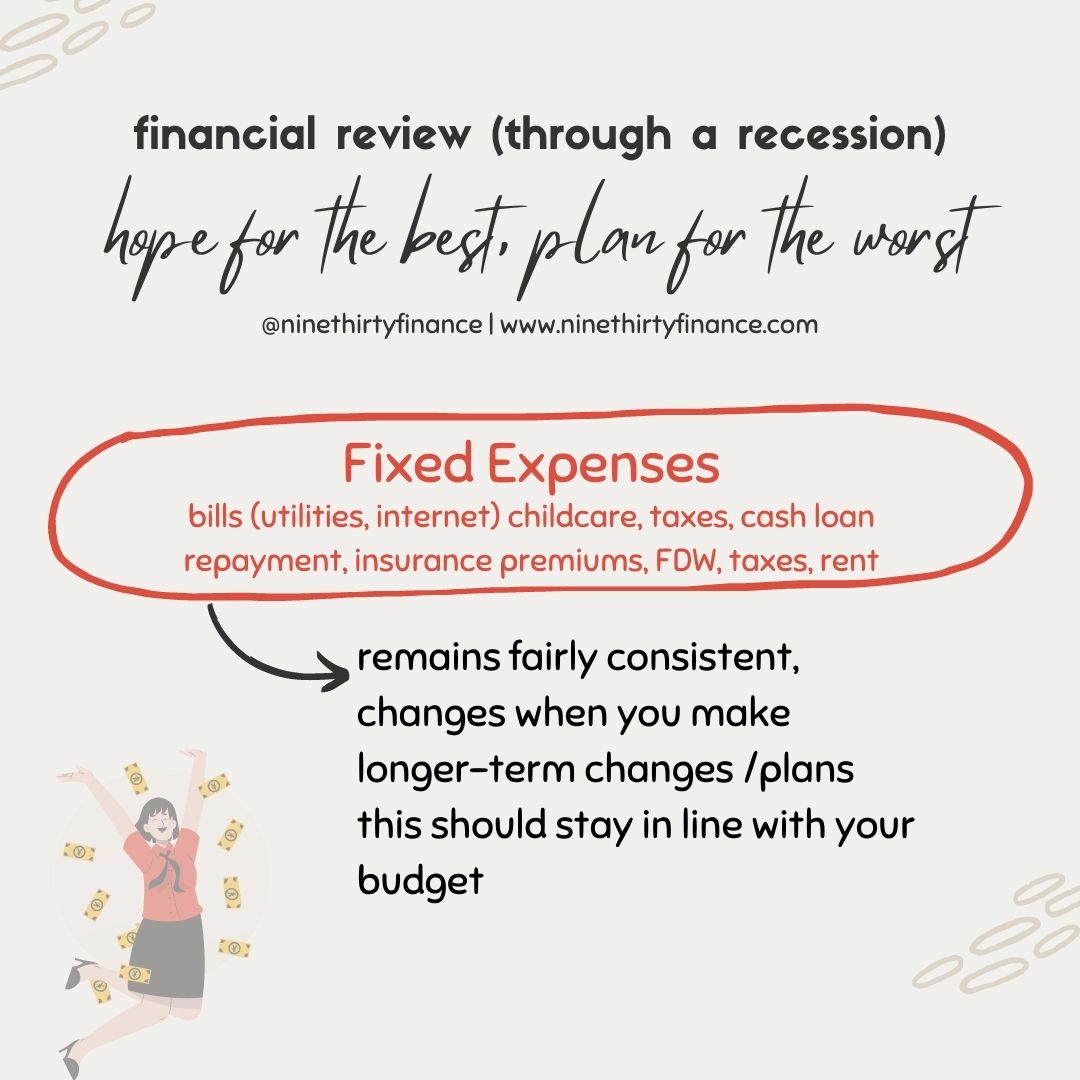
First, calculate your monthly fixed expenses. This includes bills and payments which HAVE to be paid and which remain fairly consistent in the short term – this means you can’t just make huge cuts just because you want to.

Think rent & mortgage repayments- even if you were to make lifestyle choices and move to a more modest home, the process takes time.
This is also the reason why the government has the mortgage servicing ratio and total debt servicing ratio in place to ensure financial prudence.

If a huge chunk of your income is going to fixed expenses, you may find yourself in a more stressful situation in the event of a pay cut/unemployment as it would require you to make major lifestyle changes to bring down the expense to fit the budget (or a smaller income)

To mitigate this, keep enough emergency cash or have a plan that can buy you time (such as renting out a room in the house, moving in with your parents temporary, exercising retrenchment benefits/premium holiday on your insurance plans).

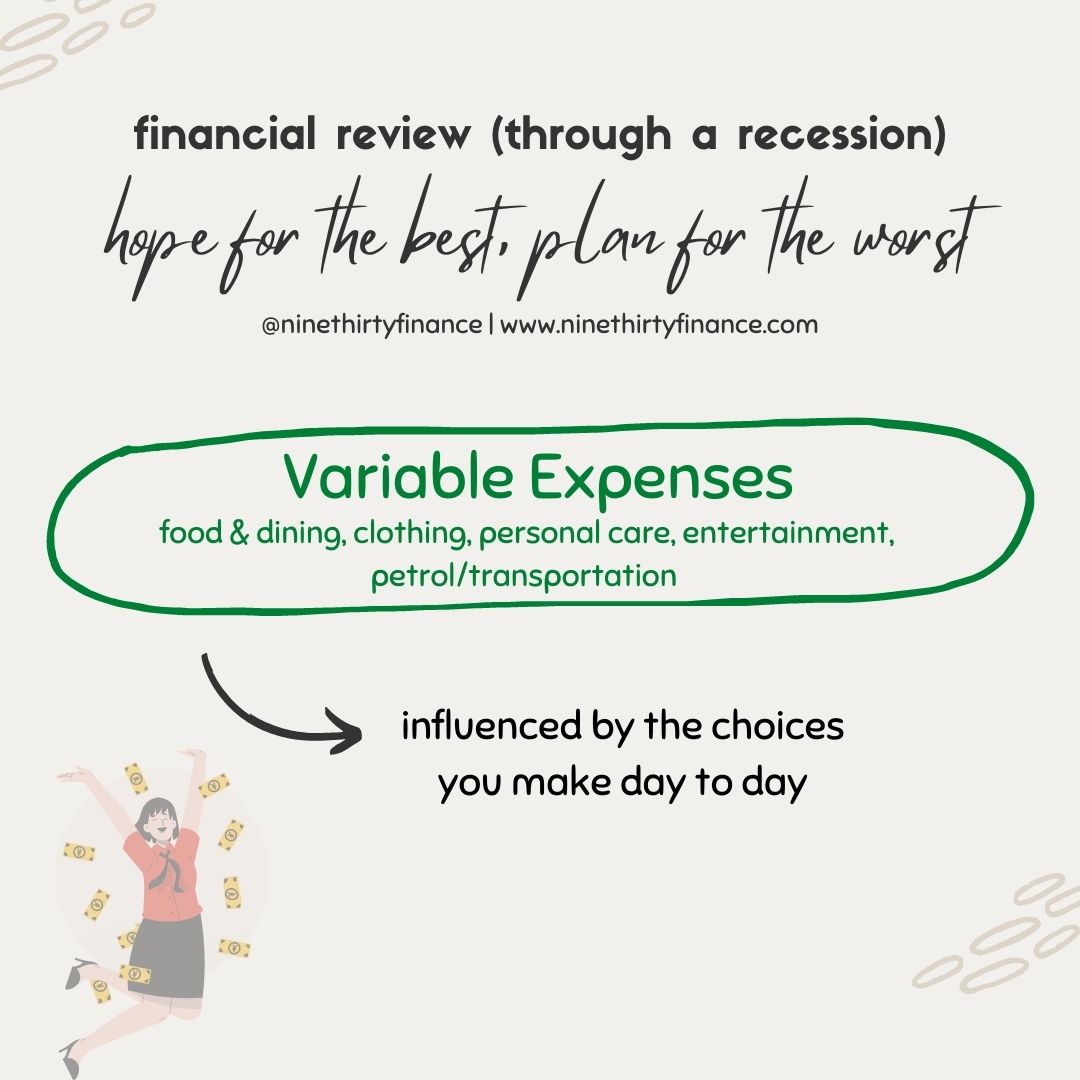
Next up, calculate your monthly variable expenses. This includes discretionary spending that can be reduced easily.

  • Food – Dining in vs preparing your own meals
    For some people, dining out could be cheaper as it may not be cost effective to cook for one. For others, having their meals at home can save a huge chunk.
  • Transport – Public transport vs driving/taking the taxi

and the list goes on.

The good news if a large part of your income goes to discretionary spending is that you can easily make adjustments when times are bad. The bad news is that human beings are creatures of habit and it can be painful to change your spending habits overnight.

If you are working in a high risk sector, you may want to start assessing your spending habits in order to be better prepared.

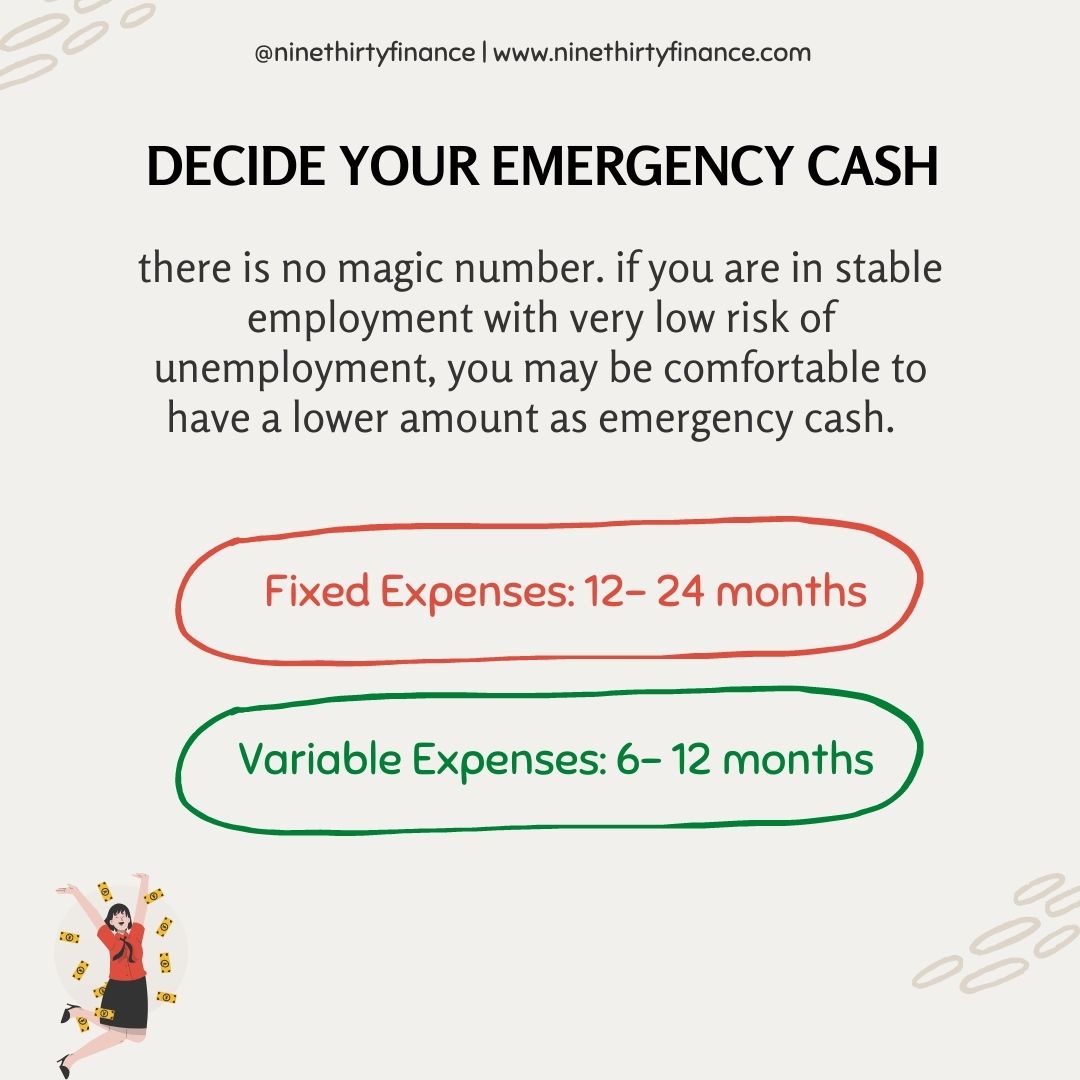
The whole point of calculating your expenses? To help you determine the level of emergency cash to keep. (No, I do not think that the commonly advocated emergency cash of 3-6 months expense is sufficient)

Example:
Monthly Fixed Expenses: $5000
Monthly Variable Expenses: $3000
Total Emergency cash to keep: $5000 * 12 + $3000*6 = $78,000

Of course, if you still aren’t convinced to do this ‘tracking exercise’, just keep 12 months of your income as emergency cash.

The Singapore Savings Bonds is currently giving a high interest rate of ~3.4%p.a. As it is a highly liquid vehicle, it is a great vehicle to use to hold your emergency cash. And the reason why I advocate this over FD/T-bills is because i do not believe that interest will stay at a high level (not 10 years, anyway) perpetually.

more on that in my future post 😉

Cancer Positive List – What is it?

Financing Curb on Outpatient Cancer Treatments & How it will affect you.

Just a few years back, Singaporeans could confidently say that their hospitalisation plan will cover them for “everything”. That is, as long as you have an as-charged plan with rider. However, the situation has since changed and the coverage from our basic health insurance (Medishield Life) and our private medical insurance are no longer like before. 

For one, co-payment is now mandatory. Insurers have also employed various methods to manage costs such as the removal of fringe benefits, encouraging treatment with panel doctors & claims-based pricing method. 

A recent change on the Curb on Cancer treatments Coverage is yet another move to contain escalating medical inflation cost in Singapore.  In 2021, the Ministry of Health (MOH) introduced a list of approved cancer drugs with proven efficacies and are known to be cost effective to help keep MediShield Life premiums sustainable for the long haul. 

This change will take place from this September 2022 (for Medishield Life) / and April 2023 (integrated shield plans): 

  • Only treatments on the positive list (approved cancer drug list) will be claimable 
  • The approved cancer drugs & services claims will also be revised to a range of $200 to $9,600/month instead of a fixed amount like before. 

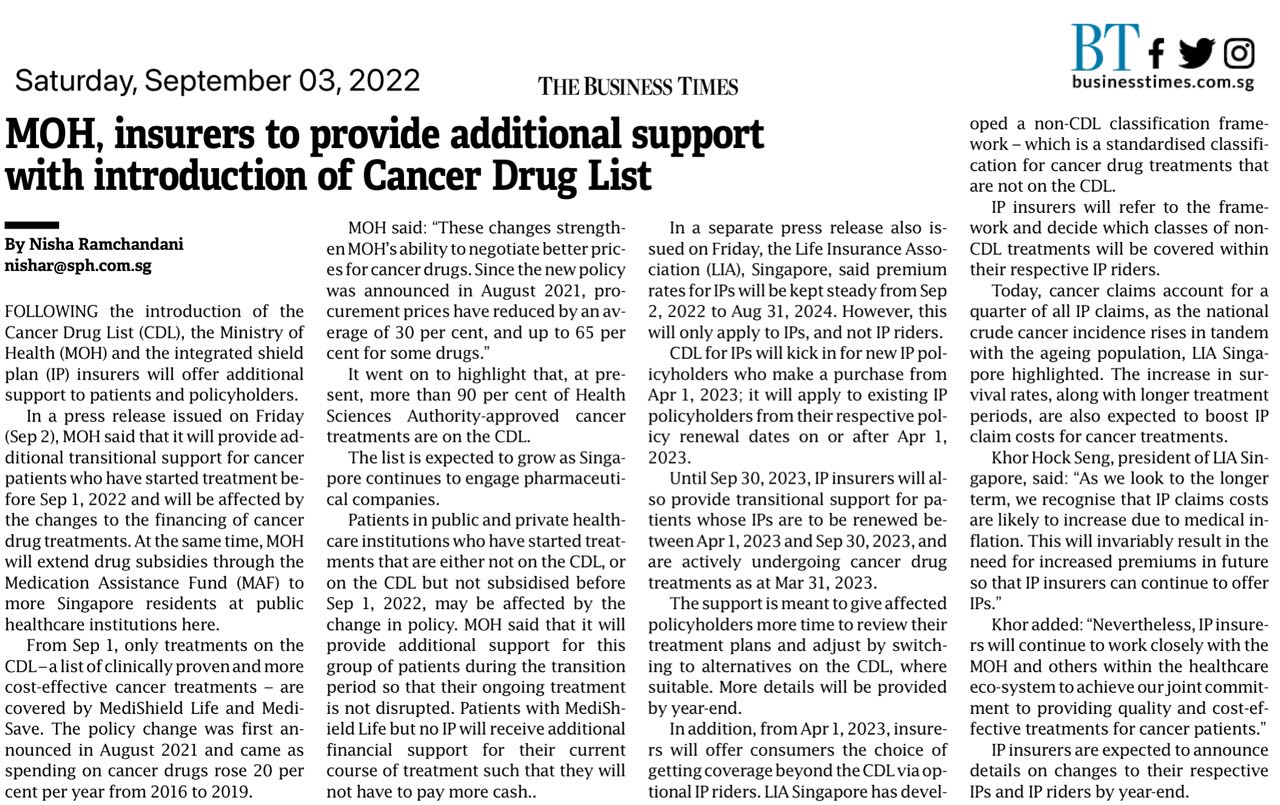
While the change is supposed to be for the ‘greater good’, this leaves many feeling insecure about their coverage. What if you require cancer treatment that is not on the list? This is the dilemma of one brain cancer patient as the new change takes effect. Soon, his cancer drug which cost $20k monthly will no longer be claimable under his shield plan. See the attached article. 

As policyholders, some of the options we can tap on if we were to face such a scenario would be: 

  1. Understand the scope of our employee benefits, if any and utilise them. 
  2. Check for options to increase our critical illness coverage upon life events on our existing policies
  3. Boost our critical illness coverage with a critical illness/cancer plan. Premium for $100,000 cancer coverage can be as low as $138-$228/year (for someone age 30) or $348-$688 (for someone age 45)

Update Sept 2022

MOH, insurers to provide additional support with introduction of Cancer Drug List

Additional info TBC

How are you accumulating for retirement?

In the course of my work, the one question I love asking clients will be their outlook towards retirement accumulation.  Recently, I’ve started to classify the attitudes of my clients in their late 20s/early 30s.

(1) The Lifelong worker: Individuals who are not too concerned about the future because they believe/want to work for as long as they can.

(2) The Live Light: Those who prefer to reduce liabilities as soon as they can to reduce financial commitment, thus allowing them to ‘semi-retire’ earlier. These are usually the ones who like to clear off their mortgages and pay up for their insurance. And as soon as they are free from liabilities, they will save aggressively for their retirement. Investment volatility? No problem – because they have no liabilities.

(3) The Early Savers: Those who prefer to save aggressively when they are young, so that they can semi-retire early with multiple sources of passive income. These are the ones who kickstart their annuities early and plan more longitudinally. They don’t mind having loans as long as their total income can cover the repayments. They do not mind investment volatility either because they have the luxury of time.

(4) Retirement? Money isn’t a problem. I am building my empire! 

There’s really no right or wrong approach to retirement planning but the important thing is to know and to plan according to your preferences. After all, different strokes for different folks and what matters is that we all get there.

Do you belong to one of the above too?

If you have been thinking about your retirement (or if you have not done it at all), feel free to try out this calculator here: https://northstar.efc.sg/link/consultant/yvonnelim/retirement 

Otherwise, just drop me a note. I promise it’ll be a fun discussion!

Affordability of cancer drug treatments and what you need to know!

Many government insurance/medical schemes have been adjusted in recent years. The latest change involves cancer treatment coverage under our Medishield Life + Integrated shield plans.

Summary

The Ministry of Health (MOH) announced that there will be changes to cancer drug treatments and this move will support the procurement of cancer drugs at better prices and help to keep MediShield Life premiums sustainable.

  • More cancer patients will be subsidised for their outpatient drug treatment
  • 90% of the existing cancer drug treatments used in the public sector will be included in the positive list of cancer drug treatments that are claimable under MediShield Life (Yay!)
  • Certain treatments will either no longer be claimable or have the claim limit lowered with no subsidy extended (nay 😦 )
  • Changes will take place from September 2022.

Currently, private integrated shield plans provide as-charged coverage for outpatient cancer drug treatments, subjected to an overall policy year limit.

To encourage the use of clinically proven and cost-effective cancer drug treatments, Integrated Shield plans will be required to only cover treatments that are on the MediShield Life positive list and set claim limits for each cancer drug treatment. According to MOH, the move will apply to all Integrated Shield Plans sold or renewed from April 2023 onwards. Claims cannot be made for drugs not on the list.

I would say that this change is for the better for most people as the overall cost of most cancer treatment will go down. However, for individuals who would prefer greater control over their treatment plans, this may come as a blow (as ~10% of the drugs may be covered only up to claim limits/ not at all).

How should you manage your financial portfolio with this change?

  • If you already have a whole life plan that pays a lump sum on Critical Illness, it will be ideal to hold the plan for life rather than cashing it out for the surrender value
  • Review and make sure that your current Critical Illness coverage is sufficient OR set aside more emergency cash to provide for situation where you wish to receive treatment/drugs not on the positive list.