What Kind of Saver are you?

2014-03-07 09.00.28

I came across an interesting article about the 8 different types of people who accumulate money, and how it is likely that we each have a dominant profile. I guess I can incorporate this into my advisory work moving forth!

October 19, 2010

By Richard Barrington| MoneyRates.com Senior Financial Analyst, CFA

  1. The paper-clip saver. These are people who build their savings rates by never throwing anything out that they might possibly need again. If you see someone saving gift wrap to re-use, don’t look down your nose at them — they may have healthier savings accounts than the average American.
  2. The master negotiator. The master negotiator loves to bargain, and saves money one haggle at a time. People who are good at this tend to do it second nature, for big and small purchases alike. When it comes to those big purchases, haggling is a skill that can really make a significant difference. If negotiating doesn’t come naturally to you, try not to look at it as an embarrassment. Instead, look at it the way the master negotiator does — almost as a game.
  3. The singles hitter. This is a person who has committed to the slow-and-steady approach to saving. They put a little aside every paycheck, and succeed at saving because they follow a consistent course over a long period of time. Continue reading What Kind of Saver are you?
Cash is Prince, Cash Flow is King

2014-02-21 09.36.56

Recently, a friend was referred to me for financial planning and it was an easy session because he already knew what he had to do- to first stop drinking (alcohol) so much, because he had other goals that he wants to pursue.
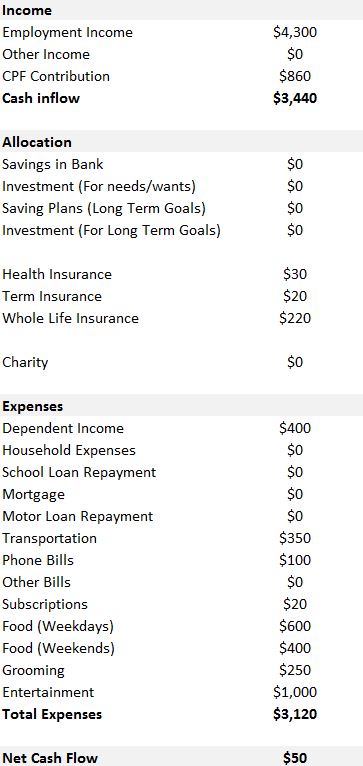
Here’s a breakdown on his cash flow (income allocation).

cashflow

At the moment, he has $7k in savings and no investment. so honestly, you don’t need a financial planner to figure the following out

The downsides of his situation:

  1. Not enough cash (Low liquidity/emergency cash)
  2. Not investing enough
  3. Not saving enough
  4. Lack stability

It’s a zero sum game so there’s no magic to this. He will have to save more and likely from all his casual drinking sessions. It’s not gonna be a fast transition to financial freedom – he will have to first develop healthier cash flow management habits, and then gradually get into a healthier financial situation.

The upsides of his situation:

  1. No liabilities
  2. Dependents do not require his support at the moment.
  3. Earns a decent income (he just started working not too long ago)

This is the edge of being an young adult.  If you are lucky, you are not bogged down by any loans and your commitment to others (dependents) would still be minimal. So basically, you already have the ticket to fly – to start a business, explore opportunities, do something/anything crazy.
But very often, this comes with prerequisites, you need to have the confidence to embark on the above. That is, a basic level of financial stability is required before you get the ticket to the opportunities out in the world. After all, living on bread and water to pursue a dream is unlikely what you would choose to do, over a long-term basis.

And most importantly, as the old (cliche) saying goes, Cash is Prince, Cash Flow is King. Regardless of what you embark on, cash flow management could be one of the first and most important skill to acquire.

For the young adults, it’s really fairly simple (simple, not easy)

  1. Know your future intentions and what you want to do with your life.
  2. Work out the numbers and direct your saving efforts towards your intentions/goals
  3. Choose the right vehicles.
    For myself, I generally save for short term goals and invest for longer term goals. There are plenty of vehicles out in the market. Choose one that works for you.
  4. Stick to it. That is, save first, spend what’s left.
  5. Continue to enjoy life

That’s all folks, for my fellow young adults out there.

What’s in it for the self employed.

2013-12-12 09.13.43

I recently read an interesting article on how Self Employed are not saving enough for Retirement and it got me thinking about the self-employed in Singapore. Well, mainly because I am a self-employed myself and because many of my clients are business owners. The conclusion I came to?

  1. Self employed do not save enough
  2. Self employed, in particular the small business owners, run the risk of betting too much on the future

But first off, here are some key points from the survey:

  • 7 in 10 Self employed are not saving regularly for retirement, if at all
  • 53% of employed have a fixed amount deducted from their paycheck on a regular basis; to save for retirement while only 8% of self employed do that
  • Self employed tend not to have clear distinction between their business cash Continue reading What’s in it for the self employed.

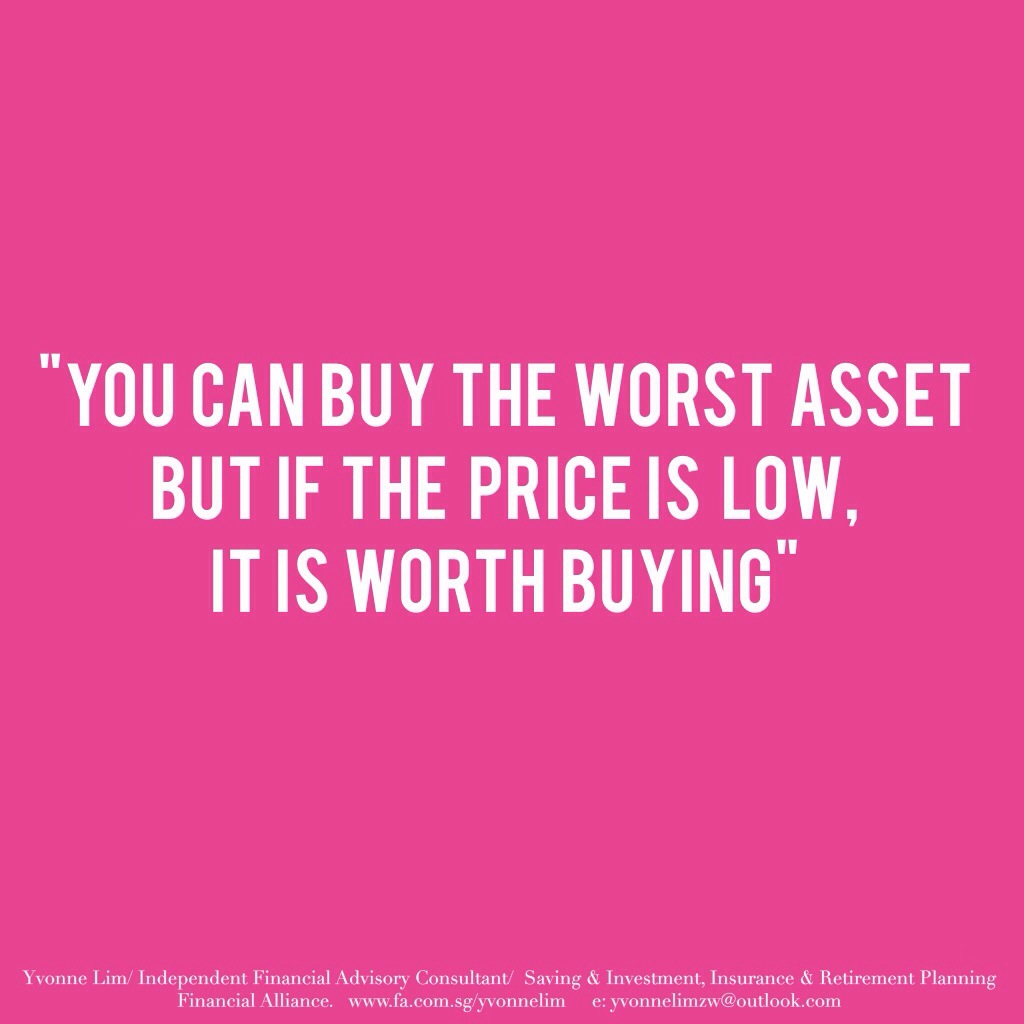
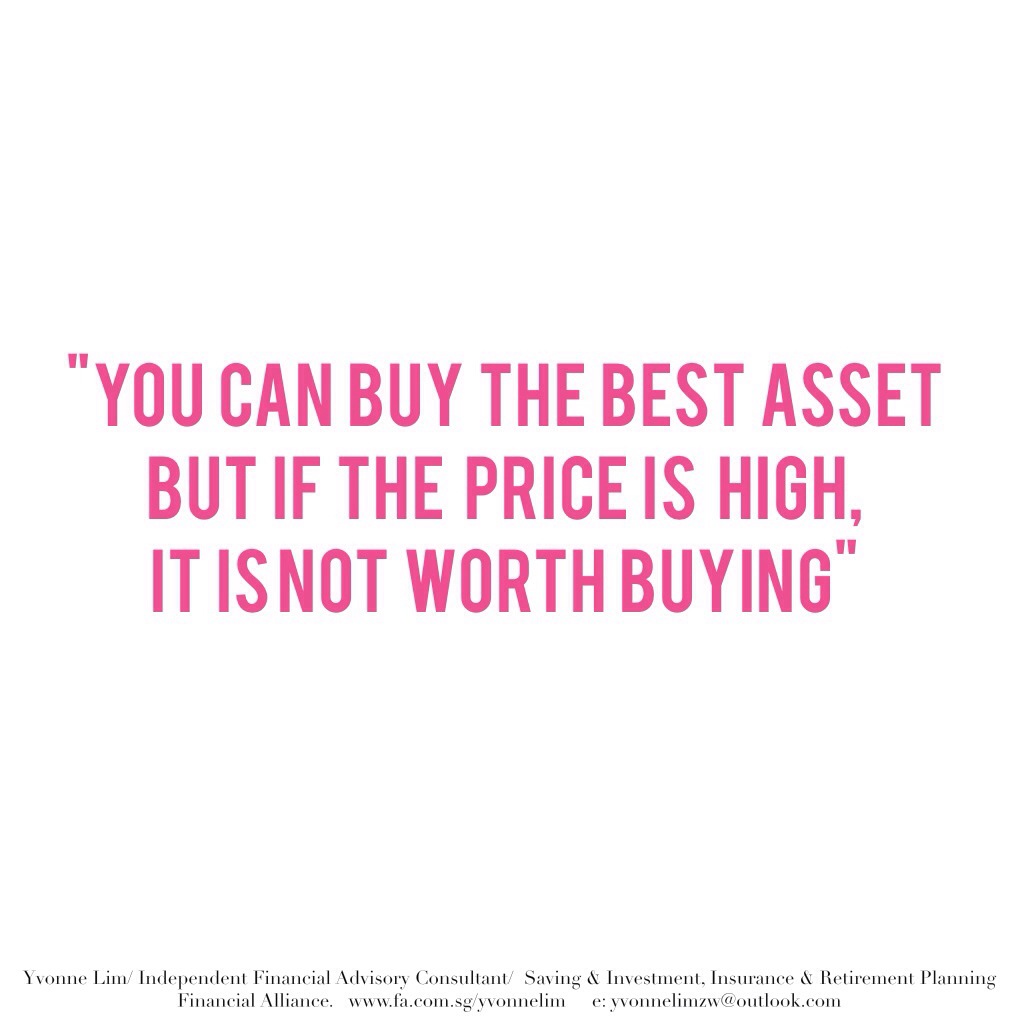
If the price is high, it is not worth buying.

20131109-003805.jpg

20131109-003815.jpg

Profit = sell price – buy price.
Every investor dreams of making great profit by buying low and selling high. But many often fall into the trap of doing the opposite. This is because when prices are high and going north, it is easy to assume that it will continue in the same path. And this optimism and overconfidence is usually why people make irrational choices of investing at a high.

Similarly, pessimism due to suppressed prices often results in neglect of potentially good investment. To be fair, it is tough to make a call when situation is gloomy and grey.

One example would be the dot com bubble in the late 90s-00s. The return for NASDAQ in 1999 alone was over 85%. Yet, investors were still pouring money into the market then – just in time for the crash when interest rates went up and when companies did not seem like they could sustain the period. No one expected this until it happened. And it did not seem possible until it did.

Another more recent example would be Gold and when prices hit 1900. This episode also allowed me to experience first-hand that emotions affect judgement and it can affect anyone- even my most savvy clients made the same mistake. After all, when your banker, friends, neighbours and colleagues are all saying the same thing, then it is easy to believe that it’s true.

so the next time you are about to make an investment, ask yourself this: “is it expensive?”

Why people put off investing #1 (and why we shouldn’t)

If you were to ask the next person you meet “Do you think Investment is important?”, I am willing to bet that most of them would reply “Yes”. However, if we were to follow up with the next question “Are you invested right now?” or “Are you investing as much as you would like?”, I believe we would get alot more ‘No’ as answers.

So why the disparity? why are people not doing what they think is important?

Well, THESE could be the reasons why:
1) underestimating the time that they have to invest (which in turn, reduces motivation to save)

2) believing that they do not have enough money to make significant impact to their financial status
3) fear of losing money
4) believing that there would be a better time to invest in the future
5) not knowing where or how to start, or who to ask

#1.  underestimating the time that they have to invest (which in turn, reduces motivation to save)

Win$1000!

If you think about it, one definite large cash need for anyone would

Continue reading Why people put off investing #1 (and why we shouldn’t)