Inflation

We’ve all heard this story before, where coffee used to cost 90 cents, now it’s $1.20. That is a whopping 33% increase! However, no one becomes a millionaire by being thrifty with coffee, so why should we be bothered by inflation? 

Inflation is the sustained increase of prices in goods and services arising from 2 main causes: 

1) Cost-push inflation 
An example of such would be, an increase in the price of fuel causing your Grab ride to be more expensive. 

2) Demand-pull inflation 
An increase in demand for a particular product causes an opportunistic increase in the raw material and skilled labour required to produce it. 

As Singapore depends on our neighbouring countries to provide us with what we need, we are susceptible to the ebb and flow of external markets. The Consumer Price Index (CPI) in Singapore has shown us:

– As of 23rd December 2021, inflation was at 3.8% year on year, the highest in 8 years 
– Electricity costs have increased by 10.7% in December 2021 
– Electricity costs have further increased by 17.2% in January 2021 (just check your bill)
– As of 23rd February 2022, inflation increased further 2.4% year on year, the highest in 9 years. 

This will likely be further exacerbated by the current Russian-Ukraine situation. 

So what can we do? 

1) Create Multiple Income Streams 

Some would call it a side hustle, or a side gig. It is not enough to depend solely on 1 income source, even Warren Buffett seconds this. “Never depend on a single source of income” – Warren Buffett“. This provides us a certain degree of protection if the main source of income diminishes. 

2) Start investing 

The 2nd half of Warren Buffett’s quote reminds us that we can never start investing too early to have a second income source. And as we all know, time in the market trumps timing the market. Having a long time horizon is probably the best way to ensure that you are able to ride through volatility and have an average rate of return that trumps the long term inflation rate.

3) Every dollar counts

Reassess your savings accounts, CPF, SRS accounts, Fixed Deposits, insurance policies. Sometimes, all we have to do is to reallocate our resources into the right place. While doing this, it is also important to take into account government policies and your entitlements to maximise your return (and this can be totally risk free).

Like to review your overall financial health? Drop me a WhatsApp for an introductory call on my advisory services.
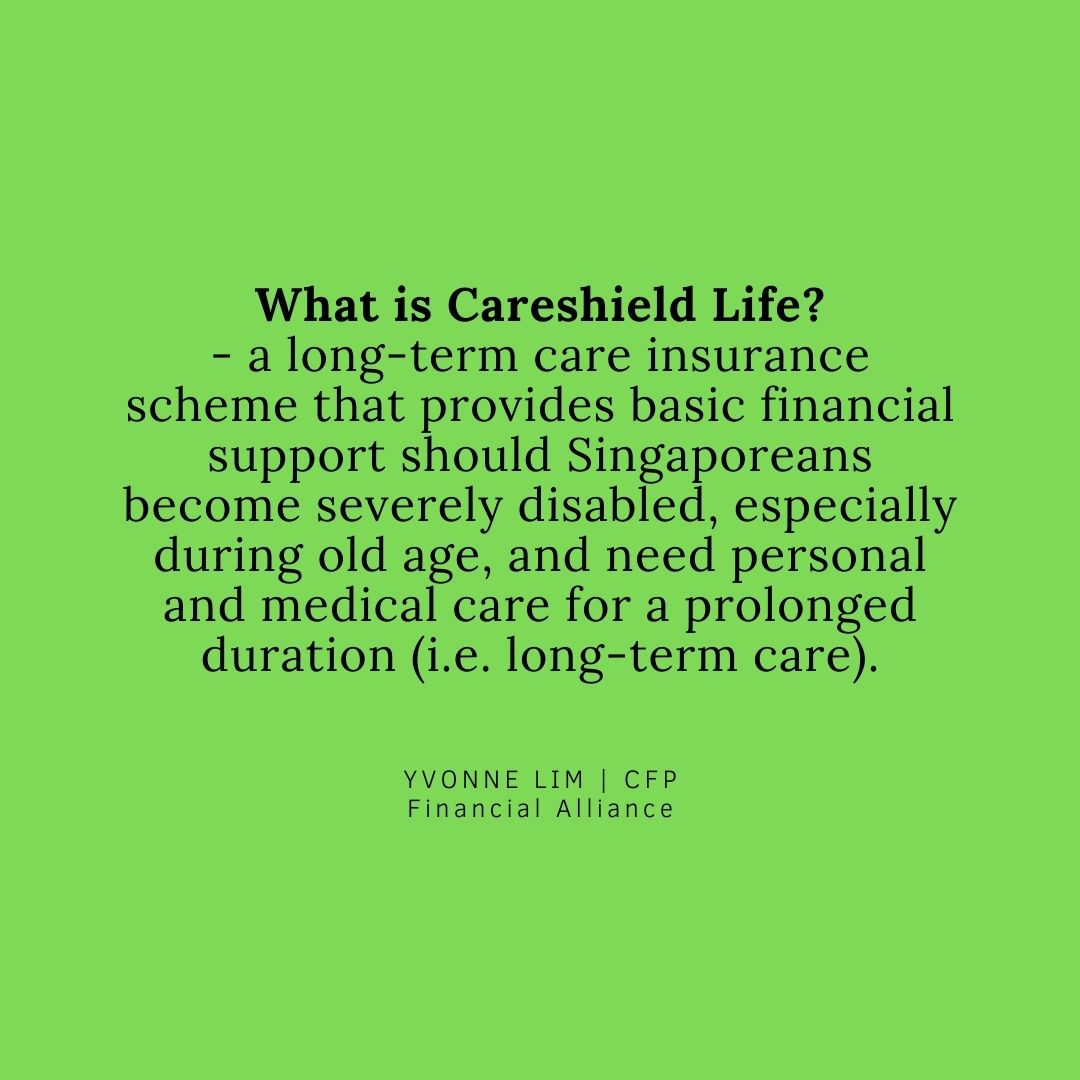
Careshield Life

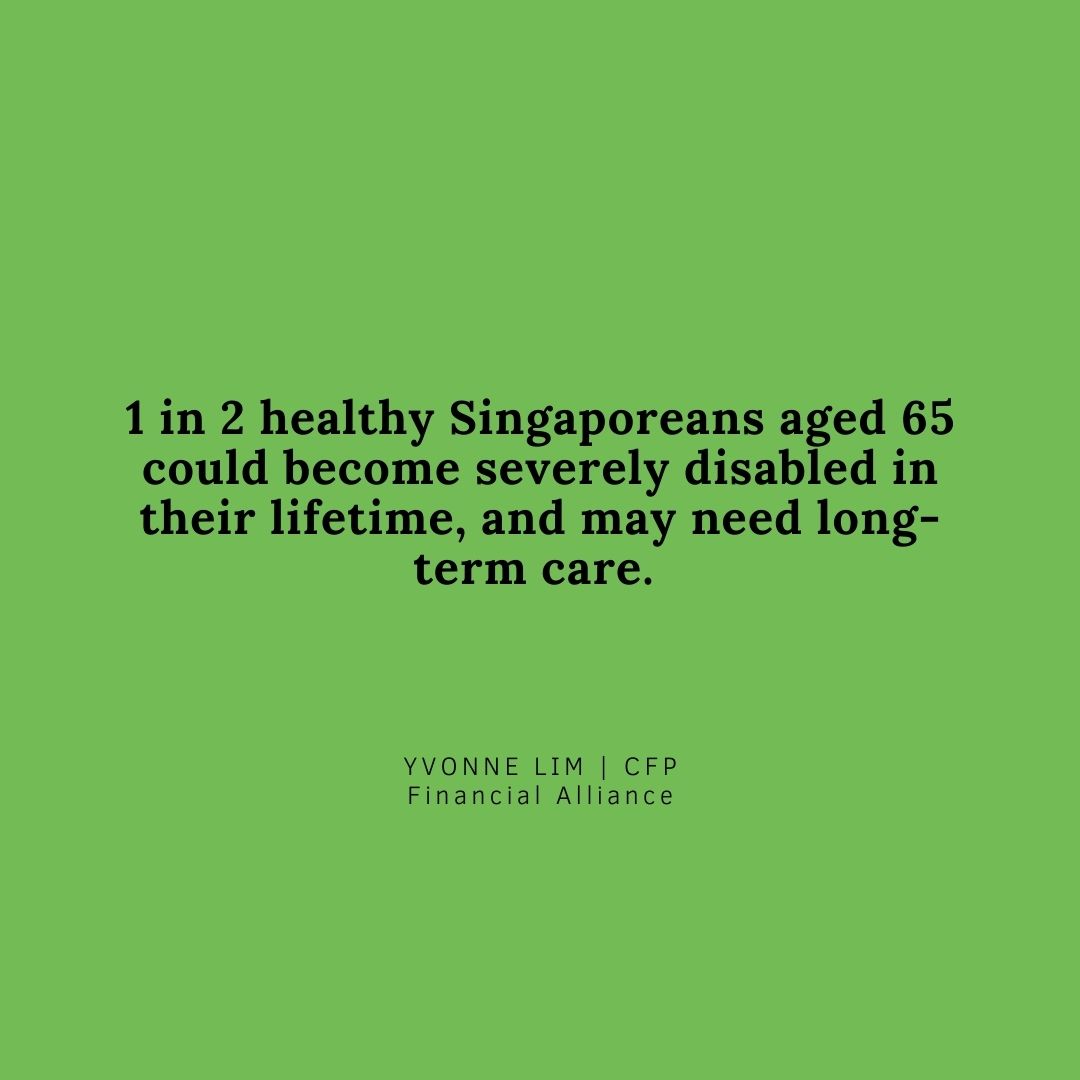
Getting enrolled into Careshield life got me thinking about my preferred care choice if I were to become severely disabled. I believe I would still want to live at home, close to my loved ones but at the same time, I can only imagine how physically and emotionally taxing it would be for the caregivers.

Money and insurance will not stop us from falling sick. But I guess a little financial help will help things a little. For example, having enough payout to

(1) Replace active income during income earning years
(2) Pay for the additional expenses of a helper/nurse to assist with the caregiving

At least with the above, there will be one less thing to worry about.

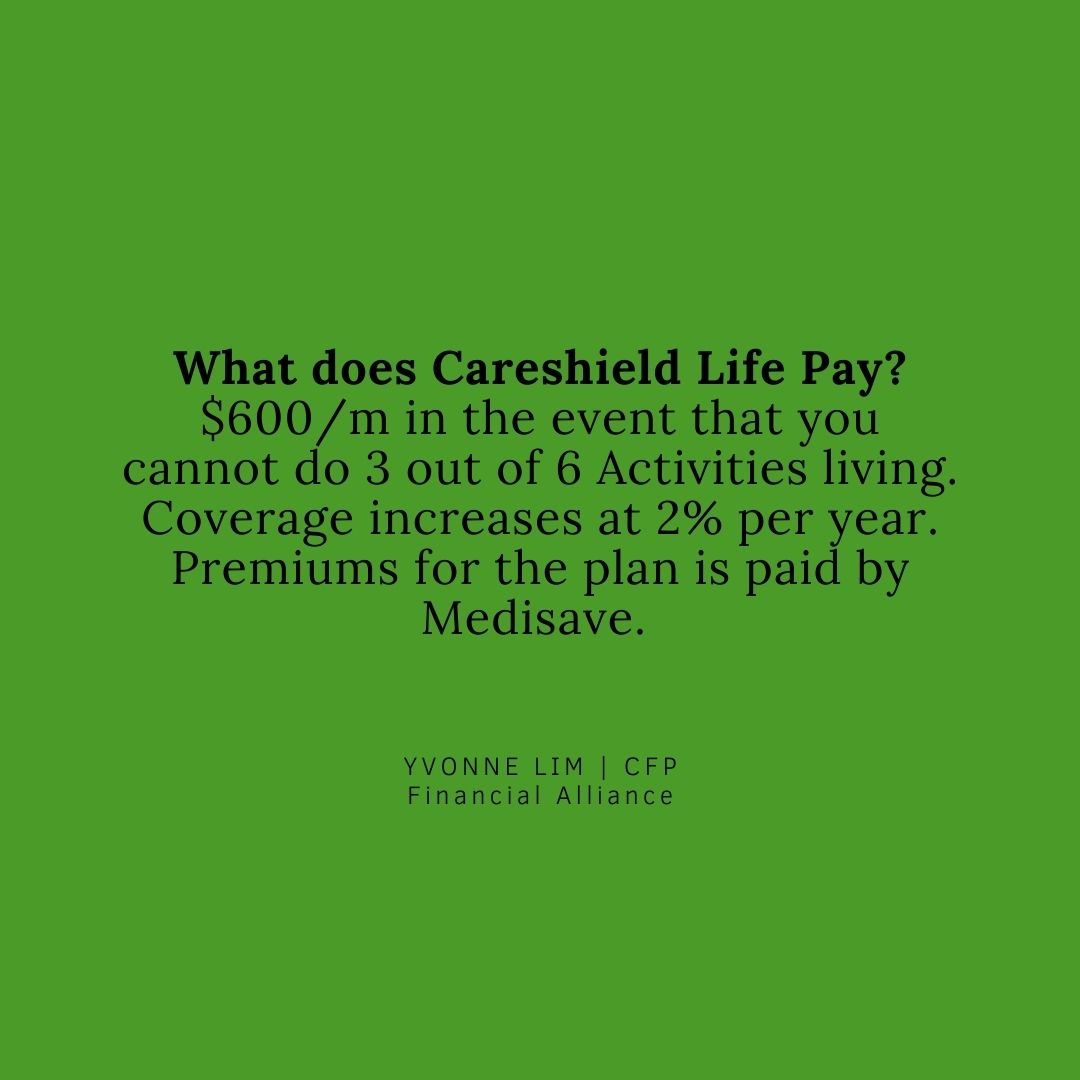
There are currently 3 insurers providing the enhancement – Aviva, Great Eastern & NTUC. The main benefits are similar (you get a higher monthly payout and you can get the payout even if you are only unable to do 2 out of 6 ADLs). Fringe benefits do differ though. So it’ll be great to talk to someone (ask me) to find out more about the plan that suits you the most.

CPF Nomination

Full article: Article by Lorna Tan.

This is an insightful article by Lorna Tan on CPF Nomination- even I gained new information that i previously did not know.

CPF nomination is something that I have always gotten my clients to do as soon as they start on the legacy planning process. Reason being that your written will does not cover CPF monies. However, there are still many individuals who believe that it is ok to solely rely on the intestate succession act (ISA) for distribution.

However, the below tidbits of information may change your mind on how a specific nomination can work in your favor.

img_4922

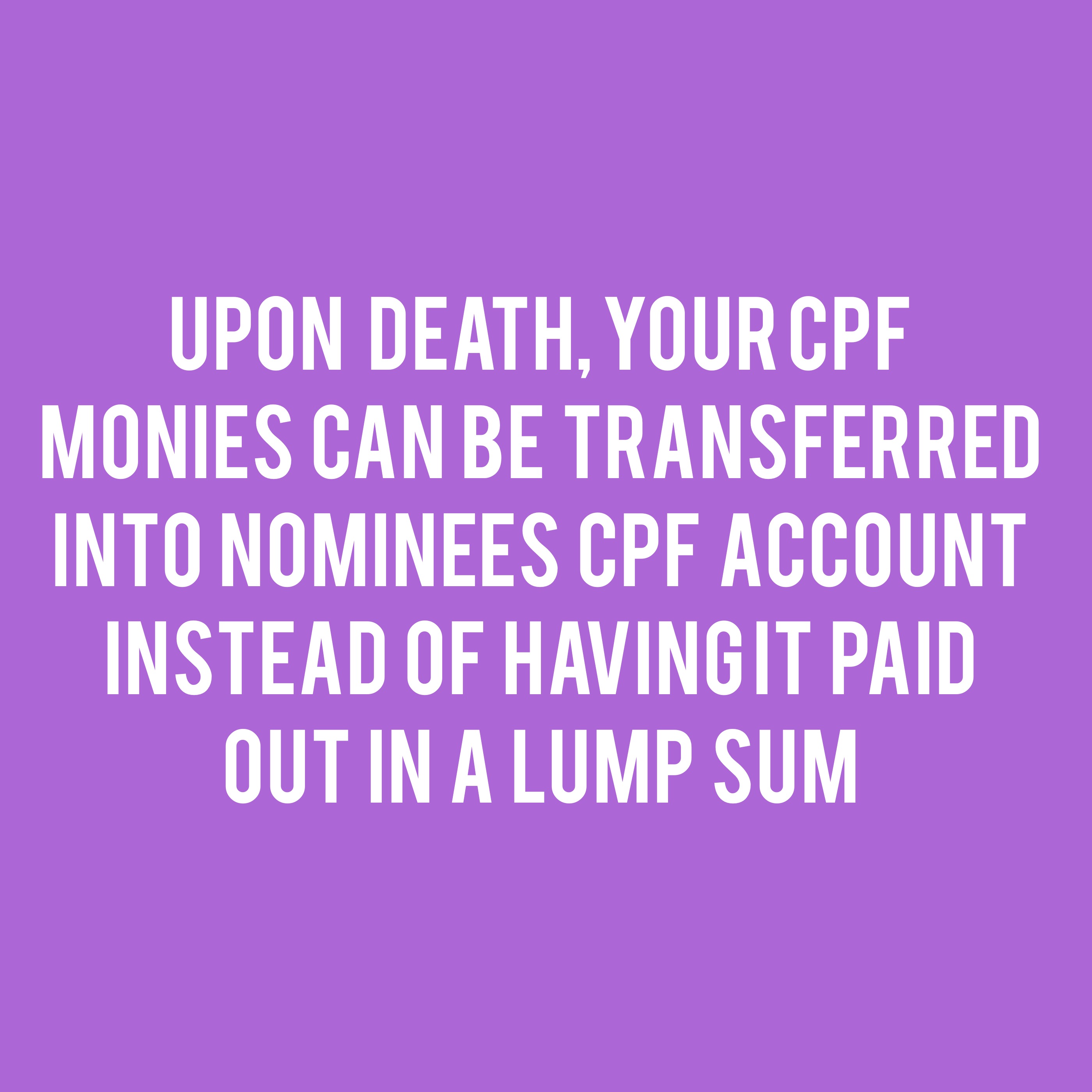
Prior to 2011, this was not possible and CPF would typically pay out a cash lump sum to the beneficiaries. However, with this option, CPF members can create a safeguard- and ensure that their nominees use the money gradually (via enhanced retirement payouts/ ensuring sufficient money to cover for healthcare needs)


img_4924img_4923

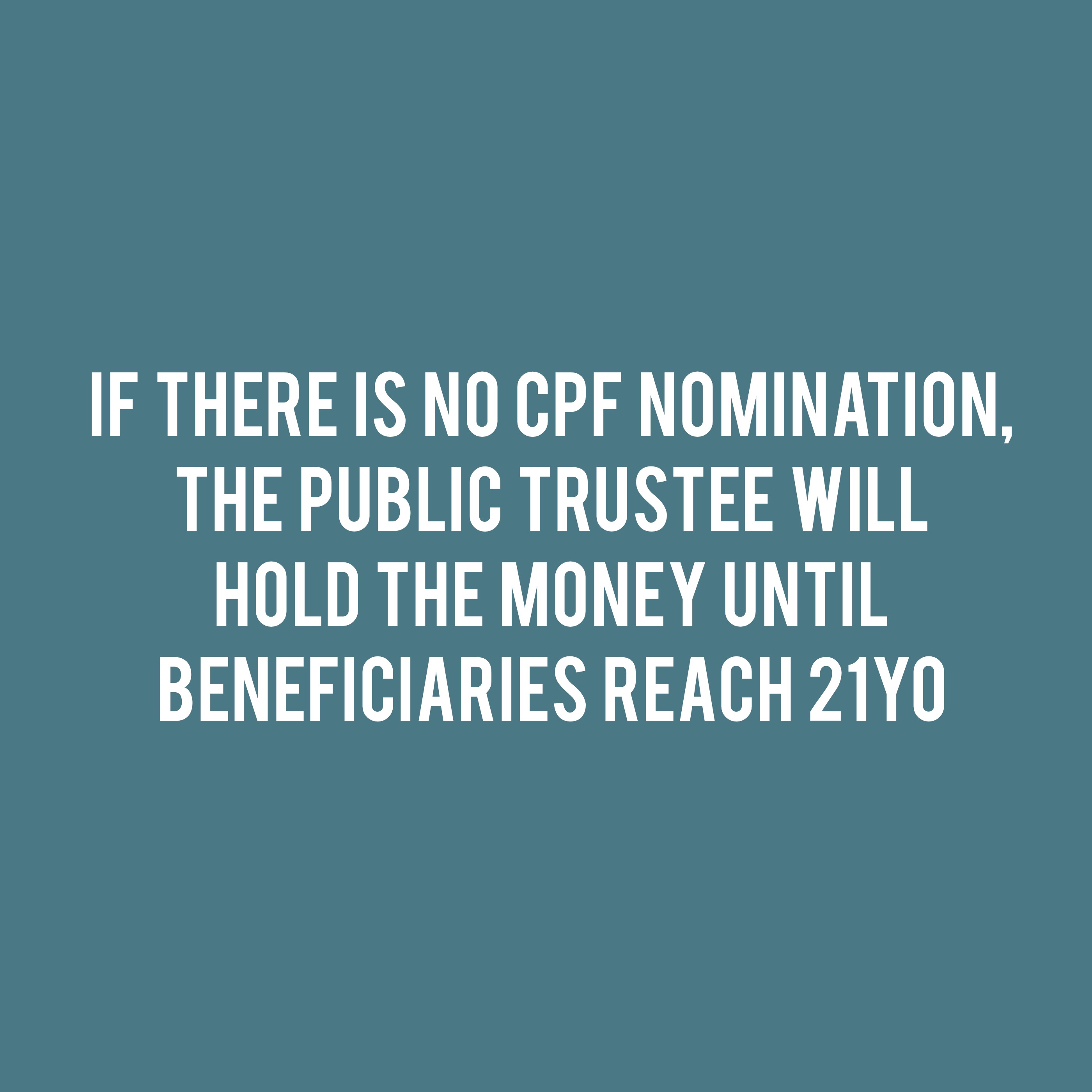
(The only exception to this is if the nominee is the deceased widow.) This could potentially be an issue if a CPF Member leaves behind no insurance/savings and is solely depending on his CPF Monies to care for his children. In view of this, I believe it is exceptionally important for CPF members to decide on the nomination rather than follow the ISA, where by default, spouse gets 50% and children get 50%.

img_4925Unknown to many, CPF actually has the special needs saving scheme that can help parents of children with special needs to save for their long-term care needs. Parents can nominate their children to receive monthly disbursements from the parent’s CPF savings after death. This scheme is administered by the Special Needs Trust Co and is probably worth looking at if of relevance.

What’s in it for the self employed.

2013-12-12 09.13.43

I recently read an interesting article on how Self Employed are not saving enough for Retirement and it got me thinking about the self-employed in Singapore. Well, mainly because I am a self-employed myself and because many of my clients are business owners. The conclusion I came to?

  1. Self employed do not save enough
  2. Self employed, in particular the small business owners, run the risk of betting too much on the future

But first off, here are some key points from the survey:

  • 7 in 10 Self employed are not saving regularly for retirement, if at all
  • 53% of employed have a fixed amount deducted from their paycheck on a regular basis; to save for retirement while only 8% of self employed do that
  • Self employed tend not to have clear distinction between their business cash Continue reading What’s in it for the self employed.

Basic understanding on your Health Schemes

Despite being on most of the Govt medical schemes & subsidies, many Singaporeans still find themselves confused. What is the purpose and the differences between Medisave & Medishield & Medifund?

Medisave (The Saving Account)

As the name suggests, Medisave is a national saving scheme introduced in April 1984. It is 1 of the 3 CPF accounts (Ordinary, Special, Medisave) whereby your monthly CPF contribution is made to. The intention of this is to help individuals set aside part of their income to meet their future personal or immediate family’s hospitalization, day surgery and certain outpatient expenses. For someone aged below 35, the income contribution going into the Medisave account is ~7%.

Medisave contribution is compulsory if you are:

  1. a self-employed person; and
  2. a Singapore citizen or Singapore permanent resident;
  3. earning a yearly net trade income# of more than $6,000.

Medishield (The Insurance)

Medishield on the other hand, is an opt-out low cost basic medical insurance scheme. The purpose of the Medishield is to shield Singaporeans against large hospital bills which cannot be covered for by the Medisave balances. Premiums for this basic insurance is payable through the Medisave account (up to a limit). Currently, the coverage extends to Class B2/C hospitalisation bills and Co-payment is required- this means that the insured will have to co-pay part of the medical bill. The coverage is also ‘Sub-limit’ and this means that there is a limit to the amount claimable for each hospitalisation category. For hospital stays in higher wards or private hospitals, coverage will be pro-rated.

Q: So what are the Integrated Shield Plans & Upgrade that I hear about?

Medishield provides basic coverage, Singaporeans seeking more comprehensive coverage would enhance their health coverage via  Medisave-approved Integrated Shield plans. These plan retain the benefits and coverage of the basic MediShield tier, while enjoying enhanced coverage provided by their private insurers.
Premiums are likewise, paid by Medisave. For individuals who do not wish to pay for any co-payment, an additional rider can be taken up along with the upgrade to cover for it. Cash premium is applicable for such riders.

Q: So who do I claim from in the event of hospitalisation? My private insurer or Medishield?

Upon upgrade, premiums are paid directly to the private insurers who will service all of your needs. The private insurers will service all claims and sort out all back-end arrangements with CPF Board to include any payouts from MediShield. You can also seek to claim from your employees benefits, if required.


MediFund
 (The safety net)

Medifund is an endowment fund set by the Government in 1993 to act as a safety net to assist needy Singaporeans who are unable to afford their medical care. The interest earned on this fund is given out to hospitals as grants to help needy Singaporeans pay for the medical bills which they cannot afford.

Source 1
Source 2