The Stranger Test

2014-04-15 09.00.15

I have a horrible habit of making impulsive purchases during my travels. So this time round, I decided to take matters in my own hands and find some way of avoiding it- so that I do not end up with clothes that I will never wear or with souvenirs that will never see the light of day and so on.

After scouring the internet for tips, I decided to practice this ‘trick’ – The Stranger Test. 

This is what you do: When you’re going to make a purchase, however big or small, picture a stranger holding your purchase in one hand and the cash it would take to buy it in the other – he is offering to give you one of the two, which would you choose? The $1,000 cheque or the new mobile phone? If you end up choosing the cash, then it would do good to keep that money in your pocket.

And it worked beautifully for me –  granted I still spent a chunk, but it’s all on things I actually like, no junk purchases. Try it the next time you are overseas. It worked for me and it may, for you.


Till my next travel….

The concept of the Stranger Test first came up in 2009 on Five Cent Nickel

Why I want to be covered for Early CI

20140227-092041.jpg

Most of the young adults who have asked me about life insurance knows that I am a believer of Early Critical Illnesses (Early CI) coverage – especially for certain profiles of people. I happen to be one because

  1. I am young and am just started out
  2. I am a self employed (your working profile)
  3. I would want to recover in style

Young
I believe early CI coverage to be important for young adults because we are all just starting out in our lives. During this stage, we are working hard to achieve our dreams and goals – making sure we will be able to pursue our needs and wants at some point in the future- get married, own our own property, start a business, travel, etc. At this stage, most young adults also probably do not have much (yet). Likely $30k- $90k (of your own money) if you have only been working for less than 3 years.

If you were to fall ill at this point, your goals would likely be disrupted- savings come to a standstill and existing savings may be depleted in the course of recovery. For this reason, I believe in early critical illness coverage. Because falling ill is bad enough without having my future goals mucked up too. So yes, I want someone (whoever/whatever it is) to give me a lump sum of money to protect my plans.

Self Employed
Having a healthy physical and mental being is of utmost importance to me as a self employed, more so as I am in the advisory line where being present is well, a prerequisite. If I were to be ill for an extended period of time, I know I would want to (will have to) hire another personal assistant so that I can direct my energy to the most important parts of the job. This would then be an additional out of pocket cost to me.

Hence, your job benefits and your role in the firm would influence your need to be covered for this early CI. Beyond the workplace, it is also ideal to consider the family – how likely would you incur additional cost for the family if you fall ill? Or on the other hand, how much are you able to (or want to) rely on the family in such an event?

Recover in style
Early CI is often not life-threatening upon detection and optimistically, most would recover from such an event. Through the course my work, some of my clients have shared their personal stories with me about how they themselves or a party of their family faced an event like this and recovered… so it got me thinking about how I would want to celebrate the recovery: simple enough, a crazy holiday for everyone. My treat.

All in all, this is why I believe in having early CI coverage for myself.. The above factors may not stay relevant forever but at this moment, something’s backing me up

***

The Solution

There are many different vehicles to use to receive early critical illness coverage. Self insurance aside, there are term plans and whole life plans. Plans that require you to pay for as long as you wish to receive the coverage, and those that require you to pay only a certain number of years. There are insurers which follow unique definitions of critical illnesses, and others which follow the standard definition. Some give an additional coverage for special stated illnesses, others that don’t. At the end of the day, all we need to do is to find one that is suitable for ourselves.

Cash is Prince, Cash Flow is King

2014-02-21 09.36.56

Recently, a friend was referred to me for financial planning and it was an easy session because he already knew what he had to do- to first stop drinking (alcohol) so much, because he had other goals that he wants to pursue.
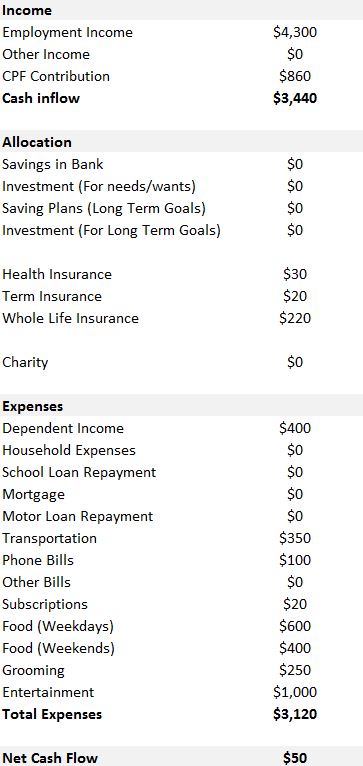
Here’s a breakdown on his cash flow (income allocation).

cashflow

At the moment, he has $7k in savings and no investment. so honestly, you don’t need a financial planner to figure the following out

The downsides of his situation:

  1. Not enough cash (Low liquidity/emergency cash)
  2. Not investing enough
  3. Not saving enough
  4. Lack stability

It’s a zero sum game so there’s no magic to this. He will have to save more and likely from all his casual drinking sessions. It’s not gonna be a fast transition to financial freedom – he will have to first develop healthier cash flow management habits, and then gradually get into a healthier financial situation.

The upsides of his situation:

  1. No liabilities
  2. Dependents do not require his support at the moment.
  3. Earns a decent income (he just started working not too long ago)

This is the edge of being an young adult.  If you are lucky, you are not bogged down by any loans and your commitment to others (dependents) would still be minimal. So basically, you already have the ticket to fly – to start a business, explore opportunities, do something/anything crazy.
But very often, this comes with prerequisites, you need to have the confidence to embark on the above. That is, a basic level of financial stability is required before you get the ticket to the opportunities out in the world. After all, living on bread and water to pursue a dream is unlikely what you would choose to do, over a long-term basis.

And most importantly, as the old (cliche) saying goes, Cash is Prince, Cash Flow is King. Regardless of what you embark on, cash flow management could be one of the first and most important skill to acquire.

For the young adults, it’s really fairly simple (simple, not easy)

  1. Know your future intentions and what you want to do with your life.
  2. Work out the numbers and direct your saving efforts towards your intentions/goals
  3. Choose the right vehicles.
    For myself, I generally save for short term goals and invest for longer term goals. There are plenty of vehicles out in the market. Choose one that works for you.
  4. Stick to it. That is, save first, spend what’s left.
  5. Continue to enjoy life

That’s all folks, for my fellow young adults out there.

a piece for myself

2014-01-21 10.15.18

Recently,I had an intense discussion with a friend (someone whom I respect alot) on my personal dreams and goals and I got a little upset because he was concerned that I would rely too much on forecasting the market and be caught off guard by what could actually happen, which by the way, would be entirely beyond prediction.

As always, all things happen for a reason and I bounced across this article by Carl Richards on how Investment Plans and Forecasts Don’t Mix and it mentioned, well, that forecasts about the future of the market are very likely to be wrong.

This drew me back to that intense conversation and got me to realise the reason for my being upset- it was not about the forecasting, it was not that I could not justify my personal/market views or enroll him in my ideas. It is about the idea of planning. It is about my life plan, the road map that I have set out for myself and which I want to follow.
And the conversation was frustrating because I felt that he doubted the idea of ‘planning’ (can you imagine how it goes against my belief on the importance for financial planning? I am a bloody financial planner!).

Anyway, now that my head’s clearer, I know I stand by what I believe – just because forecasting may not work does not mean that we leave everything to fate. Just because life is full of unexpected surprises does not mean that we do not even make guesses to put the odds in our favor. Because having a plan means that I will know where to bounce back to, if/when I make a few bad choices.

Same goes for life & investment. always back to basics:

    • Figure out where you are today
    • Make a guess about where you want to go
    • Buy diversified, low-cost investments that have the best shot of getting there 
    • Behave for a long time

that’s all folks. just a piece for myself and to continuously put the odds in my favor.

anyway, I really appreciate this friend of mine. It’s been long since I had a conversation like that and I get that it happened because he cared. All in all, a good reminder to the new year, that I gotta be on my toes and to always make the better choices for myself.

CASH DIET

2014-01-17 09.37.50

For those who are in credit card debts, this could be a pretty good new year resolution: go on a cash diet.

one of the most common reasons people use credit cards is because of the rebates/discount. BUT, the usage of credit card is one common factor attributing to emotional spending – because you simply do not feel the pain of paying. It also explains how people are ‘able’ to pay for it. not.

And to put things into perspective, if you owe $5k on your credit card, do not charge anything further to it but only repay the bare minimum every month, the total interest you would have paid at the end of the final repayment is $2,957.

Have a debt? Go on a cash diet and clear the OS fast.

Articles 1 2