Don’t pay for tomorrow’s lifestyle with today’s income

there are good debts, and then there are bad debts. It is easy to spiral out of control if we get used to spending on today’s lifestyle with tomorrow’s income – something which is apparently becoming more and more common (Credit Bureau Singapore data showed that while credit card borrowing showed no significant variation, people in their 20s have been taking on increasing amounts of other debt since the second quarter of last year).

but the silent killer? Interest rates. Yes, again.

When you save, you earn a little interest (think 2%)
With debt, you buy what you want now, but end up paying a lot of interest (think > 24% for credit cards).
To put it simply, if you have loan of $10k that you are charged 24% for, you will have to repay ~$16k at the end of 2 years just to clear the debt. Or if you repay monthly, $528/month for 2 years – a total of $12,672.

So really, for your lifestyle expenses, save before you buy.

interest rate is.. what?!

We all know that interest rates have been dropping, dropping and… dropping.

the good news? homeowners are now paying a much lower rate than before, with rates going as low as 0.9%p.a. So if you have not refinanced your home loan, you really should do it as soon as you can.

The bad news? saving rates on our deposits have also fallen to a new low. Even the bank accounts that were supposed to provide a ‘superior’ rate had also fallen. This is despite many consumers having committed to the bank’s requirements previously. This is also the reason why I am often against the idea of committing to an insurance/investment plan at the bank, just for a higher saving account rate.

So what do we do?

Recently, one of our partners (an insurer) launched a 3-years guaranteed participating saving plan (basically, this means policy does not participate in the insurer’s return so you will not get more than the guaranteed rate). The 3-year plan offers 1.8%p.a return at maturity. The plan was snapped up quickly.

In fact, within hours.

Fortunately, there are other insurers who are progressively launching similar short tenure products. However, the rates are lower, between 1.48%-1.6%p.a. So for those who are keen on such solutions, it is really important to keep in the know because these days, they are always gone before you know it. (For context, the rates for such short term plans are usually between 1.2-2.3%p.a, depending on the interest rate environment.)

Are such solutions suitable for you?

Personally, I do not hold any of such short term saving plans because
(1) I either need the money within 3 years – think emergency cash /liquidity needs or
(2) I do not need the money until 20-30 years from now, and which in this case, I would rather invest or save into a longer term saving plan that gives a higher return.

So who should get this?

I do highly recommend such plans to the pre-retirees (if they have maxed out other better saving options) or to those who have saved a lump sum for a near term use (such as renovation/education funding needs at a 3 year mark). If not, it will be better to explore other options because 1.8%p.a is really just barely beating inflation 😦

Cheers

Affordability of cancer drug treatments and what you need to know!

Many government insurance/medical schemes have been adjusted in recent years. The latest change involves cancer treatment coverage under our Medishield Life + Integrated shield plans.

Summary

The Ministry of Health (MOH) announced that there will be changes to cancer drug treatments and this move will support the procurement of cancer drugs at better prices and help to keep MediShield Life premiums sustainable.

  • More cancer patients will be subsidised for their outpatient drug treatment
  • 90% of the existing cancer drug treatments used in the public sector will be included in the positive list of cancer drug treatments that are claimable under MediShield Life (Yay!)
  • Certain treatments will either no longer be claimable or have the claim limit lowered with no subsidy extended (nay 😦 )
  • Changes will take place from September 2022.

Currently, private integrated shield plans provide as-charged coverage for outpatient cancer drug treatments, subjected to an overall policy year limit.

To encourage the use of clinically proven and cost-effective cancer drug treatments, Integrated Shield plans will be required to only cover treatments that are on the MediShield Life positive list and set claim limits for each cancer drug treatment. According to MOH, the move will apply to all Integrated Shield Plans sold or renewed from April 2023 onwards. Claims cannot be made for drugs not on the list.

I would say that this change is for the better for most people as the overall cost of most cancer treatment will go down. However, for individuals who would prefer greater control over their treatment plans, this may come as a blow (as ~10% of the drugs may be covered only up to claim limits/ not at all).

How should you manage your financial portfolio with this change?

  • If you already have a whole life plan that pays a lump sum on Critical Illness, it will be ideal to hold the plan for life rather than cashing it out for the surrender value
  • Review and make sure that your current Critical Illness coverage is sufficient OR set aside more emergency cash to provide for situation where you wish to receive treatment/drugs not on the positive list.

CPF Nomination

Full article: Article by Lorna Tan.

This is an insightful article by Lorna Tan on CPF Nomination- even I gained new information that i previously did not know.

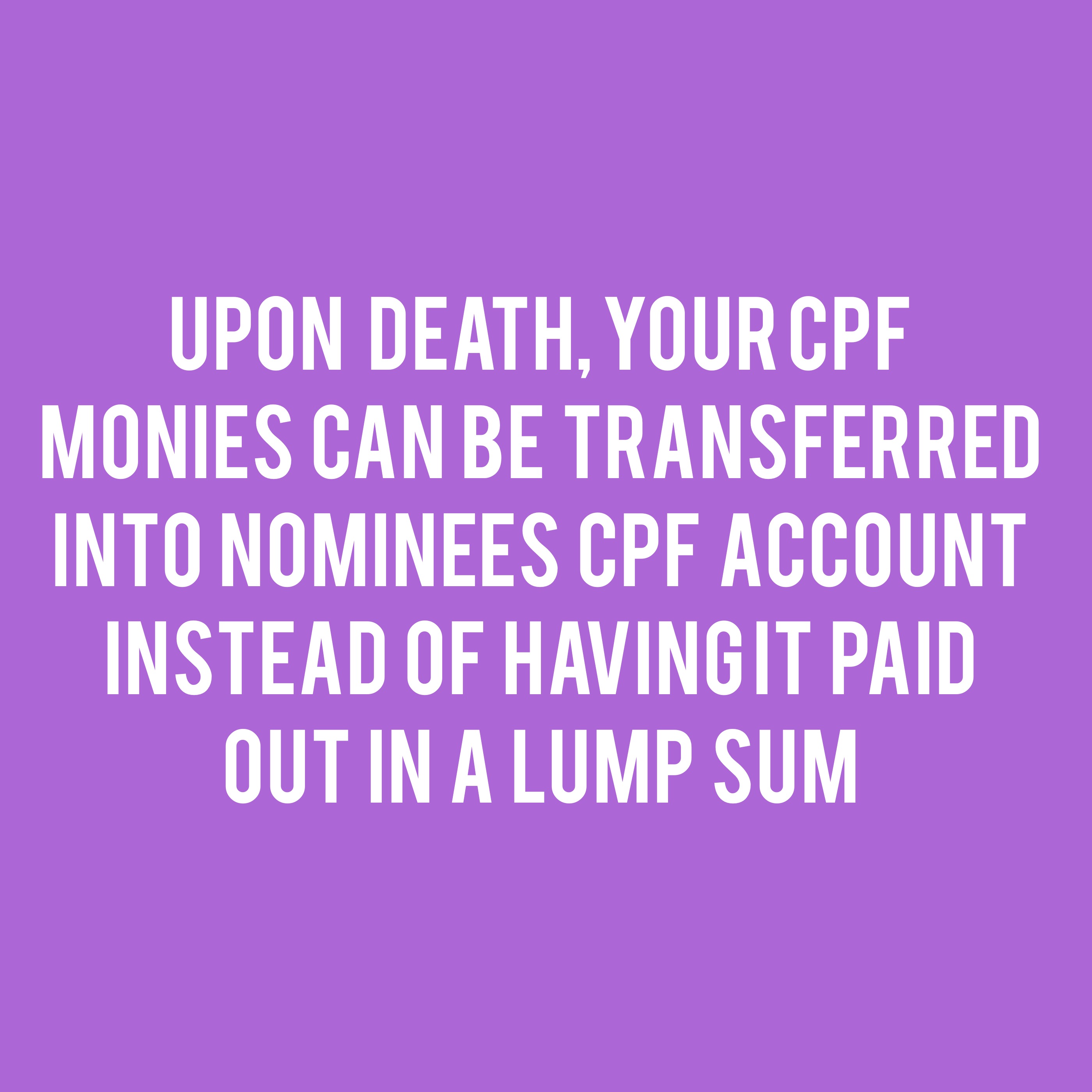
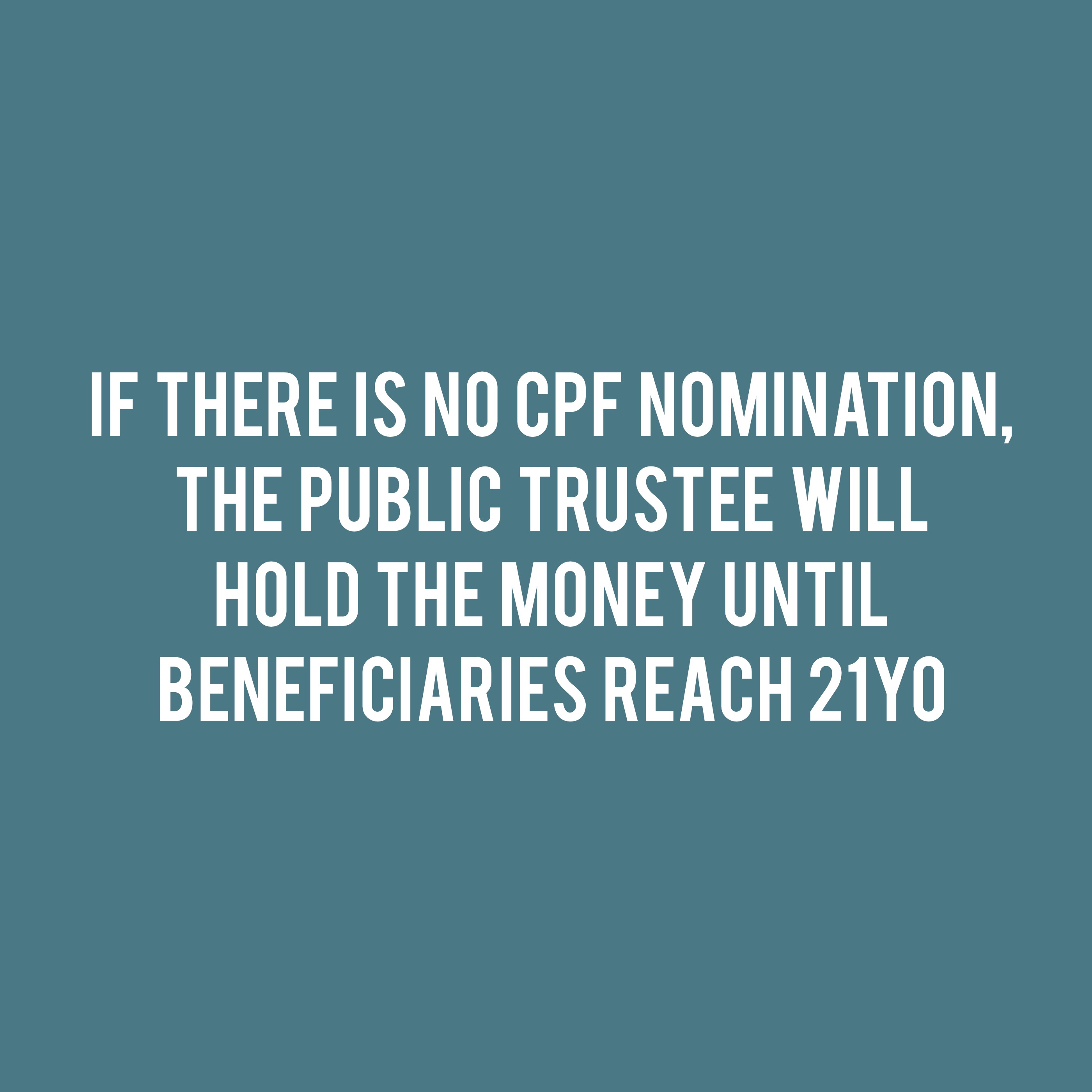
CPF nomination is something that I have always gotten my clients to do as soon as they start on the legacy planning process. Reason being that your written will does not cover CPF monies. However, there are still many individuals who believe that it is ok to solely rely on the intestate succession act (ISA) for distribution.

However, the below tidbits of information may change your mind on how a specific nomination can work in your favor.

img_4922

Prior to 2011, this was not possible and CPF would typically pay out a cash lump sum to the beneficiaries. However, with this option, CPF members can create a safeguard- and ensure that their nominees use the money gradually (via enhanced retirement payouts/ ensuring sufficient money to cover for healthcare needs)


img_4924img_4923

(The only exception to this is if the nominee is the deceased widow.) This could potentially be an issue if a CPF Member leaves behind no insurance/savings and is solely depending on his CPF Monies to care for his children. In view of this, I believe it is exceptionally important for CPF members to decide on the nomination rather than follow the ISA, where by default, spouse gets 50% and children get 50%.

img_4925Unknown to many, CPF actually has the special needs saving scheme that can help parents of children with special needs to save for their long-term care needs. Parents can nominate their children to receive monthly disbursements from the parent’s CPF savings after death. This scheme is administered by the Special Needs Trust Co and is probably worth looking at if of relevance.

What insurance to get for your newborn? Part 1

First and foremost, it is good to be back after a long hiatus from writing. Work and life’s been busy. Over the course of last year, I have held seminars at various corporations, from online retailer Zalora, to hotels such at M Hotel and other professional services firms such as NICE Systems, Perennial Real Estate etc. But now that things and processes are more settled, I’m glad to be back here 🙂

I have also made some other ‘progress’ in life. After finding my beloved, we also purchased our first residential home, got married, and I am also now hosting a little bun in the oven.

so what’s better to write about, but this?

newborn-needs

Of course, it is still a little premature for me to be writing about this since it is still months before the little one will be born. but seeing how this is now a common topic amongst my peers- some who just turned mummies and some who are becoming mummies, I feel like now would be the best time to start the series. What insurance will my newborn need?

(i will not be talking about the prenatal maternity insurance here, but you can text me separately to find out my view on it, and to find out which plan is the most ideal. For the newly weds who are excited about family planning and want to know more about the International Health Plans that cover for delivery costs, feel free to just give me a call too)

So first off…
health-ins

This is perhaps, the most straightforward and important insurance to get for our children. Upon birth, your child will be covered under the Medishield Life Scheme, which is the nation’s health insurance.

Medishield Life covers for Government Hospitals for B2/C wards, and limits of coverage and co-payment applies. So most parents would enhance the child’s coverage to a Private Medical Integrated Shield Plan that cover the child fully, from Govt to Private hospitals, thereby transferring the financial obligations to the insurer in the event of hospitalisation (be it due to high fever/ any unfortunate complication when young).

Enrolling our newborn when they are young is also crucial because more likely than not, they would be at their healthiest stage, with no prior medical records/conditions.

There are 6 different insurers in Singapore providing Private Medical Integrated Shield Plan and each insurer provides the coverage via 2 parts – Main Plan (takes care of almost 90% of bill) and Rider Plan (takes care of the remaining 10% of bill + other benefits).

Below is a simple comparison on the relative strength on each plan (based on private as-charged cover with rider). Because it is still best to discuss this in detail with an advisor to find out what is best for you, I have excluded the names of the insurers specifically. Drop me a whatsapp and i’ll be happy to share in great detail about it.

Shield Plan.png


Disclaimer: Info correct as of date of post.
private medical insurance all provide a good level of coverage for the most important of matters. Insurers with red cells simply have the worst relative coverage, but not poor coverage on its own. There are pros and cons for each insurer and it would be ideal to speak to your adviser to find out which serves you best.  The plans stated here do not include international health plans.

So here it is, the first part of the <What insurance to get for your newborn?>  series. Do look out for more in the coming week 🙂

and for my dear friends and clients who are reading this, if you have had good experience with how I have assisted you with your finances (be it for insurance or investment), do share this article  and my services with your loved ones too. So I know that I have been doing the right thing and can continue doing it for more people.

And for those who are reading this and may be shy to ask more, please do not be. Regardless of whether we set up a advisor-client relationship or not, I will always be more than happy to share. likewise, just drop me a FB message/text.

 

yvonne