
Teach your kids to budget! Try this.

Parents of young children frequently ask me a recurring question: “What is the best approach to teach my kids about personal finance?” While the task itself may not be overly challenging, finding an enjoyable and non-materialistic approach can be. To tackle this, I have begun exploring a different way by focusing on teaching children the concept of “resource planning” instead of purely financial planning.
 
And the resource? SNACKS.
 
My kids (Riley & Rowan) are now on a Snack Budget. They receive a limited amount of snacks per month and they are allowed to make their own choices on when/what they want to eat. So far, I think it’s been fairly effective. It instils responsibility AND it saves me my sanity. I no longer have to deal with their constant requests for snacks. Here is a short summary of the steps involved in this approach:
 
1. Explain the concept: Start by explaining the idea of limited resources, budgeting and allocation. Explain it through themes such as Time, Money & Resource (in this case, snacks).
 
2. Set a monthly snack allowance: Determine a reasonable amount of snacks that your child can have in a month. This could be a fixed number. You can also set some rules. For example, snacks are only allowed after breakfast, or snacks are only allowed to be taken out from a dedicated snack box. (It will also be wise to keep a higher proportion of quality snacks at home, to manage the diet).
 
3. Track and plan: Help your kids create a simple tracking system, such as a chart or a notebook. Personally, I print this out for them. Every time they grab a snack, they would have to cross out one ‘token’. The snack tokens only get replenished at the start of the next month. 
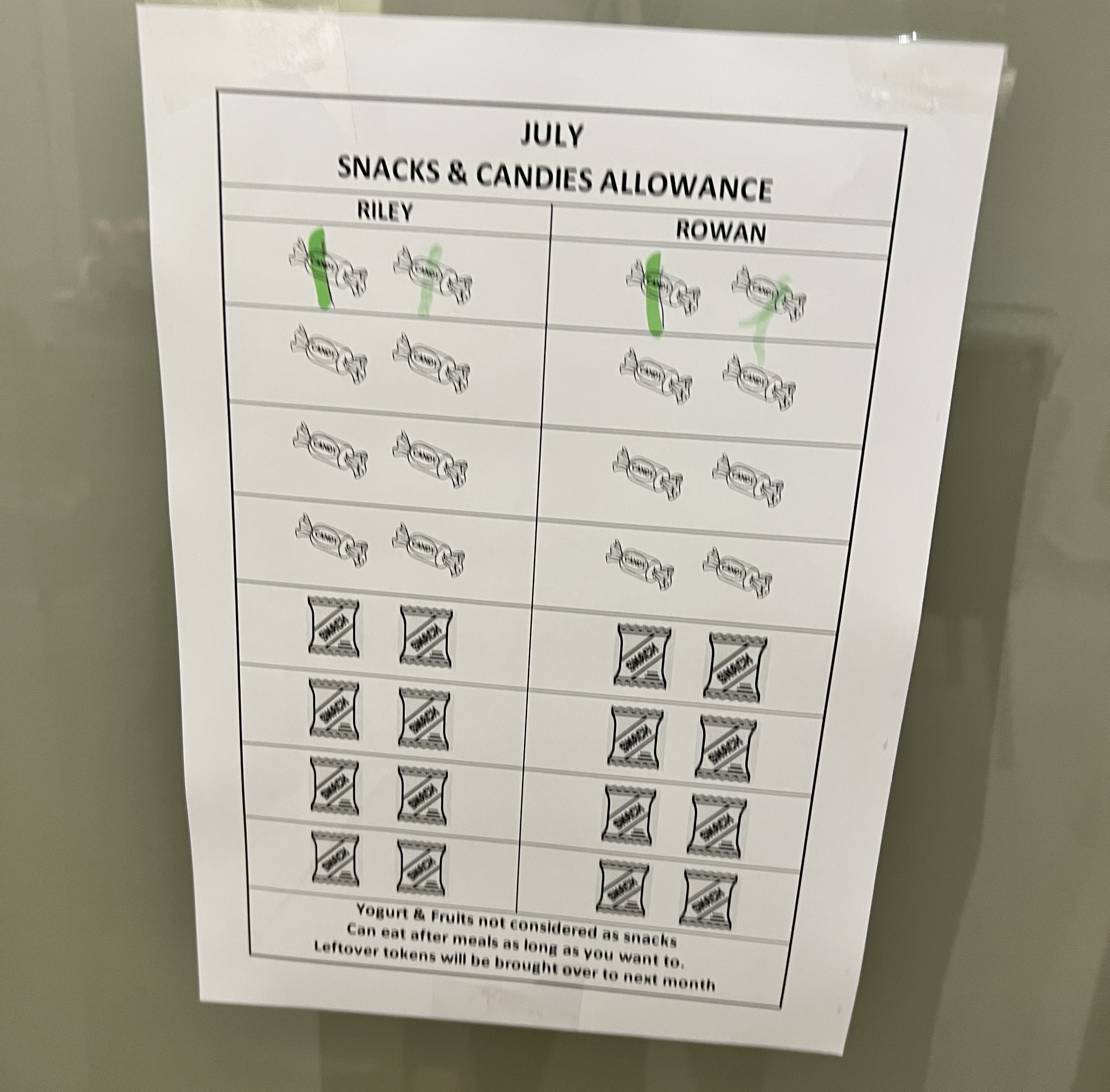

 
If your kids older:
 
4. Involve them in the shopping: Take them along when grocery shopping and involve them in making choices. Give them an allowance ($), and allow them to choose their own snacks. This will help them understand the value of money and the importance of making good choices.
 
5. Encourage saving: Teach your child the benefits of saving money. If they manage to have some snacks left at the end of the month, encourage them to save that extra amount for future goals or treats.
 
By teaching children budgeting through limited snack allowances, they can learn valuable lessons about money management & making choices. This approach can lay a strong foundation for their financial & personal well-being in the future.

If you try this and it works, do drop me a note too. would love to hear more about it 😉

GST Voucher 2023 – and how you can fight inflation if you are not eligible to receive the payout

1.5 million Singaporeans to receive $1.2 billion in GST Voucher!
If you are wondering if you are ELIGIBLE, you can easily check out the following link (log in via singpass): https://www.gstvoucher.gov.sg
 
If you are wondering WHEN you will receive the GST Voucher, it depends on whether you are NRIC-Paynow registered.

  • For PayNow:  1 August 2023
  • For Bank crediting: 11 August 2023
  • For GovCash: 21 August 2023 
    (Citizens on GovCash may withdraw their GSTV – Cash at OCBC ATMs island wide by entering their 1) Payment Reference Number (PRN) that will be sent to them from 21 August, their 2) NRIC, and after passing the 3) facial verification.)

$700 may not be much but it can still offset the increase in GST for $70,000 worth of purchase/spending. This will be helpful for the lower to middle-income and senior Singaporeans, who are eligible for the payout.

And for those who are not receiving any payouts (if we view it optimistically, it’s a happy problem), here are some investment ideas on how you can fight inflation by making better financial choices:

  1. Invest in Stocks: Stocks have a track record of being a good hedge against inflation. During periods of high inflation, companies can increase prices for their products and services, leading to higher revenues and potentially higher stock prices. It’s important to choose resilient companies with a history of performing well in inflationary environments, or to choose companies who have strong pricing power (think luxury!)
  2. Invest in Real Estate: Real estate is a tangible asset that can help safeguard against inflation. As inflation rises, the value of real estate tends to increase. As we have seen in recent months, rental income also goes up int imes of inflation. Of course, not everyone can invest in a second/third property given the high prices and stamp duties. In this case, REITS may be good options to consider.
  3. Invest in commodities: Certain commodities, such as gold, silver, and oil, have historically served as good hedges against inflation. Precious metals are often considered stores of value during times of uncertainty and inflation. You can invest in these commodities via various investment vehicles, such as ETFs, contracts, or physically holding the commodities themselves. You can also consider investing in stock of related companies (point 1).

The above are just some examples of what you can do to hedge against rising inflation/ GST. Please speak to your financial advisor (or contact me) and conduct a proper review before making any financial decisions 😉

NTUC Income Gro Capital Ease

Insurers have been launching various short-term endowment plans over the last 1 year.

Income (known as NTUC previously) has also recently launched a 3 years endowment plan that pays 3.55%p.a. But the reason why I am highlighting the product isn’t for the product itself, but for their marketing message “3 is better than 2”.

IMO, that’s great copywriting (probably written by someone with good financial knowledge too). So if you are wondering if Income Gro Capital Ease is a good saving plan /option, my short answer is yes.

Here’s why.
Back when saving interest rates were really low, it would have been better to do shorter tenure saving plans / plans with flexibility so that we could cash out and reinvest somewhere if interest rates rise. However, in the current environment where our short term savings rates are relatively high (for Singapore at least), it is actually better to opt for the longer tenure plans to lock in a higher rate.
The reverse is true for borrowing rates – which is why I had advise clients to go for the DBS 5 Years Fixed rate previously.

If you are interested to find out more about Income Gro Capital Ease, drop me a note or simply head over to their website to find out more: https://www.income.com.sg/savings-and-investments/gro-capital-ease.

But most importantly, do remember that before selecting the plan/vehicle, it is essential to assess your goals and priorities first.

cheers

Cancer among millennials. Young but not invincible

When we are young, it is easy to perceive ourselves as invincible, believing that health issues, including serious illnesses like cancer will only affect older folks. However, the statistics have spoken – youth does not grant immunity to health challenges.
 
Full article here: https://www.ft.com/content/90d5f2e3-d539-4149-a503-2114ac3ef355
 
In Summary 
Over the past 30 years, there has been a significant increase in the number of young people developing cancer. This rise in “early onset” cancer among those under 50 years old has been called an epidemic by experts. 
Data shows that cancer rates in people aged 25 to 29 have increased by 22% between 1990 and 2019 in developed countries. Rates for 20- to 34-year-olds in these countries are now at their highest level in 30 years. Among 15- to 39-year-olds, cases of colorectal cancer increased 70%.
 
Some Possible reasons:
(1) Changes in diet: The consumption of food high in saturated fat and sugar (for millennials in their early life) is believed to alter the composition of the microbiome in ways that can harm an individual’s health.
 
(2) Changes in lifestyle: sedentary behaviour, and excessive alcohol consumption, are prevalent among millennials. These lifestyle choices can contribute to obesity, which is linked to an increased risk of several cancers, including breast, colorectal, and pancreatic cancer. Alcohol also increases the risk for several cancers (mouth, pharynx, larynx and esophagus).
 
(3) Delayed Childbearing: The decision to delay childbearing has become more prevalent among millennials due to various reasons. Giving birth for the first time at a young age are factors known to confer protection against breast cance.
 
 
Spotting cancer early:
Early detection can greatly improve the chances of successful treatment. Some early signs to take note of are:
 
(1) Unexplained Weight Loss: If you’re experiencing unintended weight loss without any changes in diet or physical activity.
(2) Persistent Fatigue: Feeling constantly tired and lacking energy, despite getting enough rest.
(3) Unusual Changes in the Body. For example, the presence of new lumps or bumps, changes in the size, shape, or color of moles, persistent pain in specific areas, unexplained bleeding or bruising, or changes in bowel or bladder habits.
(and if you ever feel uncertain or in doubt, just consult a doctor!)
 
What you can do for yourself/loved ones:
(1) Stay in tune with your body and look out for red flags
(2) Make fitness, a healthy diet and health a priority. 
(3) Review your own insurance coverage
(4) Review your children coverage
(5) Spread the awareness

For a review of your coverage, you can contact me here

The basic things you need to know, if you are a Self-employed, hustler or freelancer in Singapore

If you are a self-employed individual in Singapore, there are several aspects of finances that you should pay close attention to. Managing your finances effectively is crucial for the success and sustainability of your self-employment/ hustling life~

Here are 6 important things to keep in mind:

  1. Know your taxes!
    Understand your tax responsibilities and ensure timely filing of your tax returns. Familiarize yourself with the applicable tax rates and deductions available for self-employed individuals.
    Tax Reliefs: https://www.iras.gov.sg/taxes/individual-income-tax/basics-of-individual-income-tax/tax-reliefs-rebates-and-deductions/tax-reliefs
    Guides available on IRAS: https://www.iras.gov.sg/taxes/individual-income-tax/self-employed-and-partnerships/tax-obligations-by-industry-trade-or-profession 

  2. Keep it organised!
    Maintain accurate financial records to track your income and expenses. As you income /expenses go up, consider using accounting software or hiring a professional to assist you with bookkeeping tasks. It also gives you a better idea of how profitable you really are.

  3. Money moves! So take note of your budget & cash flow.
    Create a realistic budget to allocate your income and expenses effectively. Ensure you have sufficient funds for both personal and business needs. Cash is queen. Cashflow is king!

  4. Future Planning -Plan for your retirement.
    Unlike employees, self-employed individuals do not have mandatory Central Provident Fund (CPF) contributions. Therefore, it is crucial to plan and save for your retirement through alternative means, such as voluntary CPF contributions or other retirement savings vehicles to ensure streams of guaranteed income in retirement.
    Note: Self employed individuals are also required to make mandatory Medisave contribution. You can find out more here: https://www.cpf.gov.sg/member/growing-your-savings/cpf-contributions/saving-as-a-self-employed-person

  5. Protect yourself from life’s surprises with insurance.
    As self-employed, you do not enjoy employee insurance benefits. Take care of yourself, check out health insurance, critical illness insurance, and business insurance. Ensure that you have adequate coverage to protect yourself and your business from unexpected events.
    At the different stages, different vehicles may work to your favor. In the early years, a term plan may be idea to keep premiums low. But if budget allows, a life plan may be a better solution in the long run.

  6. Stay in the know, continue learning.
    Stay updated with the latest financial regulations, tax changes, and government schemes that may benefit self-employed individuals. Attend workshops or seek professional advice to level up your financial knowledge and skills.
    OR, you can also reach out to me, a Certified Financial Planner @ Financial Alliance to find out more.

By paying attention to these key financial aspects, you can better manage your finances as a self-employed 😉