Inflation

We’ve all heard this story before, where coffee used to cost 90 cents, now it’s $1.20. That is a whopping 33% increase! However, no one becomes a millionaire by being thrifty with coffee, so why should we be bothered by inflation? 

Inflation is the sustained increase of prices in goods and services arising from 2 main causes: 

1) Cost-push inflation 
An example of such would be, an increase in the price of fuel causing your Grab ride to be more expensive. 

2) Demand-pull inflation 
An increase in demand for a particular product causes an opportunistic increase in the raw material and skilled labour required to produce it. 

As Singapore depends on our neighbouring countries to provide us with what we need, we are susceptible to the ebb and flow of external markets. The Consumer Price Index (CPI) in Singapore has shown us:

– As of 23rd December 2021, inflation was at 3.8% year on year, the highest in 8 years 
– Electricity costs have increased by 10.7% in December 2021 
– Electricity costs have further increased by 17.2% in January 2021 (just check your bill)
– As of 23rd February 2022, inflation increased further 2.4% year on year, the highest in 9 years. 

This will likely be further exacerbated by the current Russian-Ukraine situation. 

So what can we do? 

1) Create Multiple Income Streams 

Some would call it a side hustle, or a side gig. It is not enough to depend solely on 1 income source, even Warren Buffett seconds this. “Never depend on a single source of income” – Warren Buffett“. This provides us a certain degree of protection if the main source of income diminishes. 

2) Start investing 

The 2nd half of Warren Buffett’s quote reminds us that we can never start investing too early to have a second income source. And as we all know, time in the market trumps timing the market. Having a long time horizon is probably the best way to ensure that you are able to ride through volatility and have an average rate of return that trumps the long term inflation rate.

3) Every dollar counts

Reassess your savings accounts, CPF, SRS accounts, Fixed Deposits, insurance policies. Sometimes, all we have to do is to reallocate our resources into the right place. While doing this, it is also important to take into account government policies and your entitlements to maximise your return (and this can be totally risk free).

Like to review your overall financial health? Drop me a WhatsApp for an introductory call on my advisory services.
Careshield Life

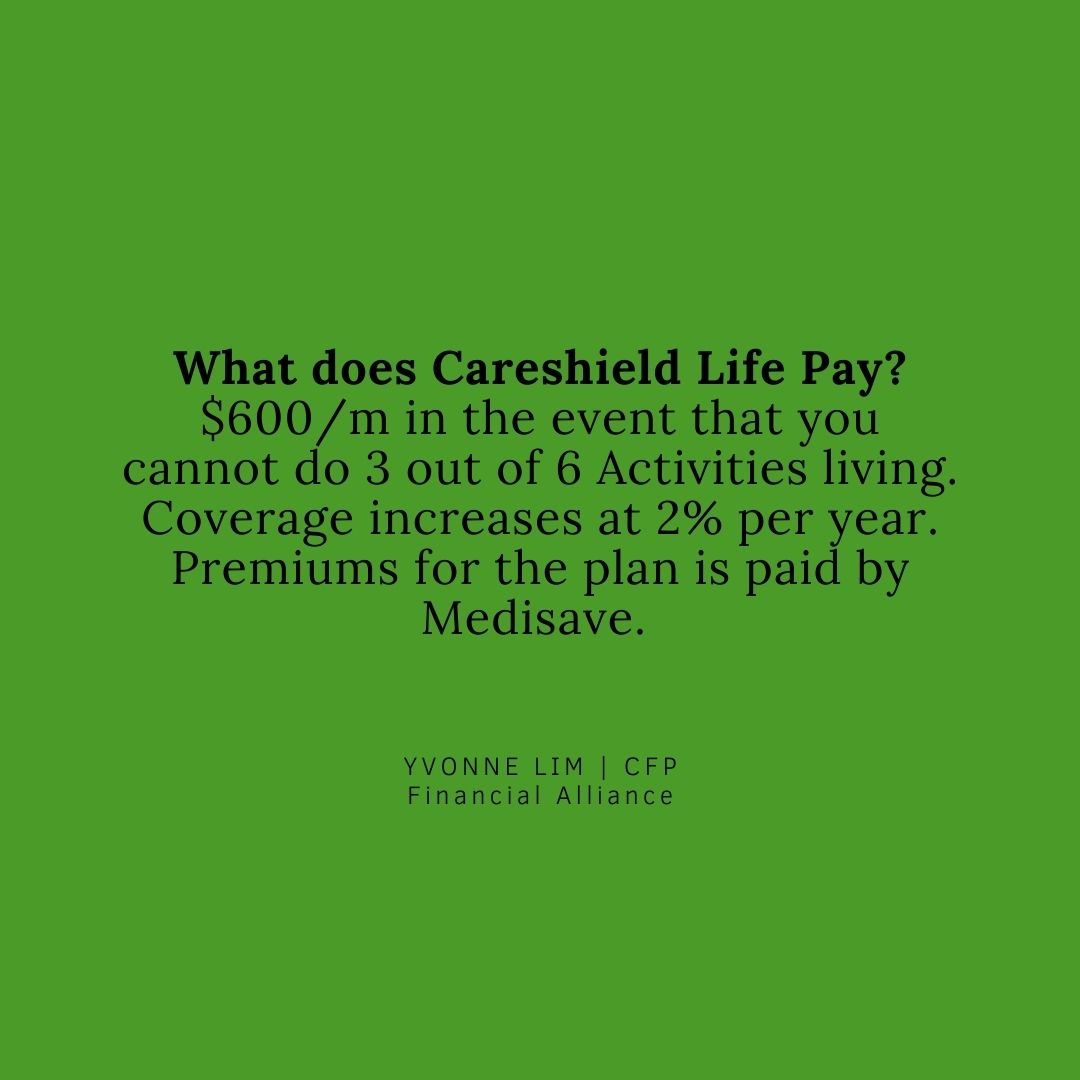
Getting enrolled into Careshield life got me thinking about my preferred care choice if I were to become severely disabled. I believe I would still want to live at home, close to my loved ones but at the same time, I can only imagine how physically and emotionally taxing it would be for the caregivers.

Money and insurance will not stop us from falling sick. But I guess a little financial help will help things a little. For example, having enough payout to

(1) Replace active income during income earning years
(2) Pay for the additional expenses of a helper/nurse to assist with the caregiving

At least with the above, there will be one less thing to worry about.

There are currently 3 insurers providing the enhancement – Aviva, Great Eastern & NTUC. The main benefits are similar (you get a higher monthly payout and you can get the payout even if you are only unable to do 2 out of 6 ADLs). Fringe benefits do differ though. So it’ll be great to talk to someone (ask me) to find out more about the plan that suits you the most.

Don’t pay for tomorrow’s lifestyle with today’s income

there are good debts, and then there are bad debts. It is easy to spiral out of control if we get used to spending on today’s lifestyle with tomorrow’s income – something which is apparently becoming more and more common (Credit Bureau Singapore data showed that while credit card borrowing showed no significant variation, people in their 20s have been taking on increasing amounts of other debt since the second quarter of last year).

but the silent killer? Interest rates. Yes, again.

When you save, you earn a little interest (think 2%)
With debt, you buy what you want now, but end up paying a lot of interest (think > 24% for credit cards).
To put it simply, if you have loan of $10k that you are charged 24% for, you will have to repay ~$16k at the end of 2 years just to clear the debt. Or if you repay monthly, $528/month for 2 years – a total of $12,672.

So really, for your lifestyle expenses, save before you buy.

interest rate is.. what?!

We all know that interest rates have been dropping, dropping and… dropping.

the good news? homeowners are now paying a much lower rate than before, with rates going as low as 0.9%p.a. So if you have not refinanced your home loan, you really should do it as soon as you can.

The bad news? saving rates on our deposits have also fallen to a new low. Even the bank accounts that were supposed to provide a ‘superior’ rate had also fallen. This is despite many consumers having committed to the bank’s requirements previously. This is also the reason why I am often against the idea of committing to an insurance/investment plan at the bank, just for a higher saving account rate.

So what do we do?

Recently, one of our partners (an insurer) launched a 3-years guaranteed participating saving plan (basically, this means policy does not participate in the insurer’s return so you will not get more than the guaranteed rate). The 3-year plan offers 1.8%p.a return at maturity. The plan was snapped up quickly.

In fact, within hours.

Fortunately, there are other insurers who are progressively launching similar short tenure products. However, the rates are lower, between 1.48%-1.6%p.a. So for those who are keen on such solutions, it is really important to keep in the know because these days, they are always gone before you know it. (For context, the rates for such short term plans are usually between 1.2-2.3%p.a, depending on the interest rate environment.)

Are such solutions suitable for you?

Personally, I do not hold any of such short term saving plans because
(1) I either need the money within 3 years – think emergency cash /liquidity needs or
(2) I do not need the money until 20-30 years from now, and which in this case, I would rather invest or save into a longer term saving plan that gives a higher return.

So who should get this?

I do highly recommend such plans to the pre-retirees (if they have maxed out other better saving options) or to those who have saved a lump sum for a near term use (such as renovation/education funding needs at a 3 year mark). If not, it will be better to explore other options because 1.8%p.a is really just barely beating inflation 😦

Cheers